
News Release
Media
What Metal Gears Do Different Products Need? A Guide from Industrial Equipment and Automotive Applications to Smart Devices
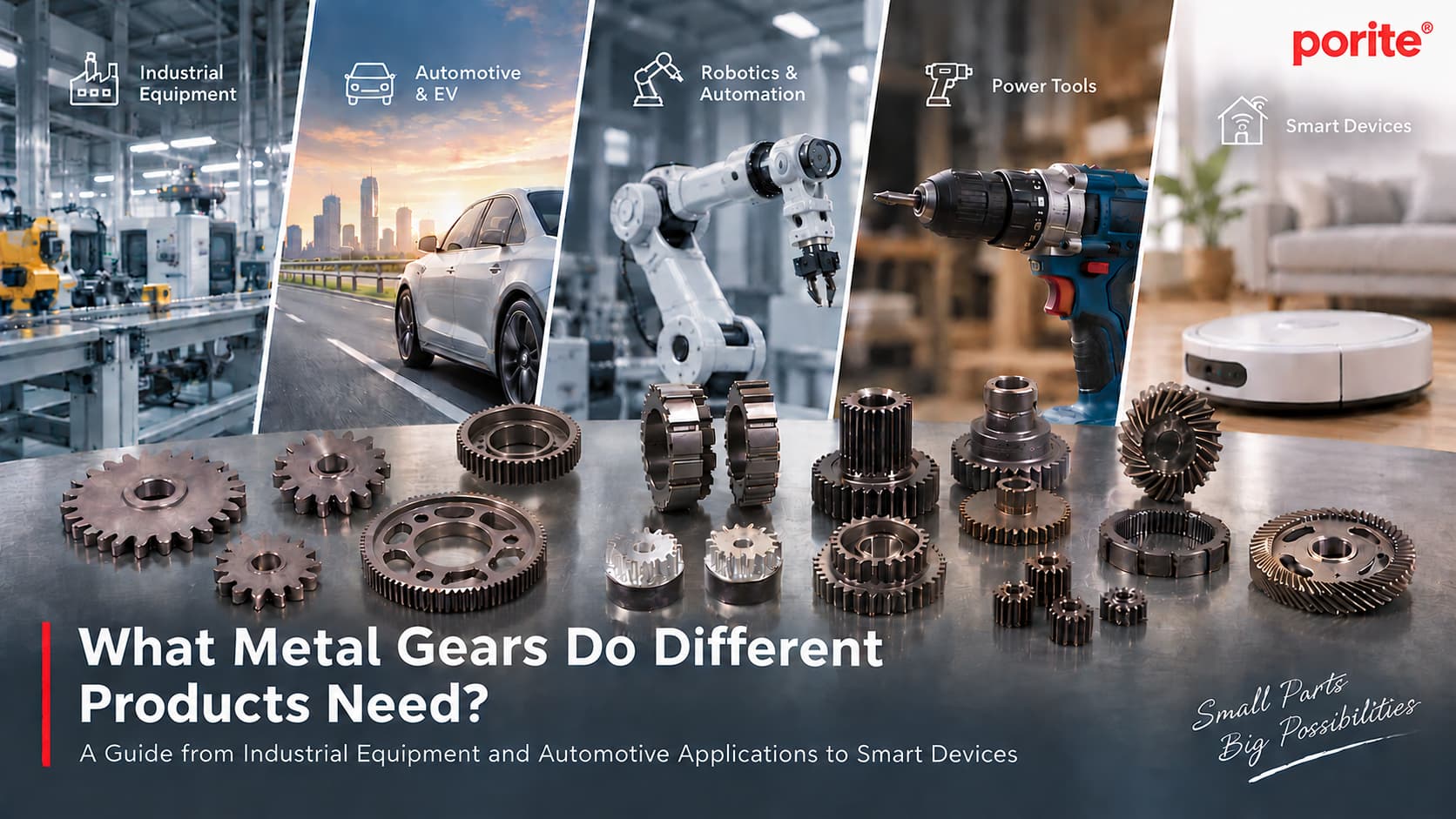
Metal gears may seem like just one component within a transmission system, but in practice, they can directly affect torque transmission, operating accuracy, noise, durability, and even overall manufacturing cost.
More importantly, there is no single type of metal gear that is suitable for every product.
Industrial equipment may prioritize long-term load capacity. Automotive and electric vehicle applications must also consider durability, noise, and mass-production consistency. Robotics place greater emphasis on precision, compact size, and transmission performance. In robotic vacuums, smart appliances, and other smart devices, low noise, compactness, and cost often become more important.
So when selecting metal gears, the real question is not:
“Which gear is the best?”
It is:
“What kind of gear does my product actually need?”
Porite Taiwan has long been involved in Powder Metallurgy (PM), High Density & High Performance Powder Metallurgy (HPM), and gear-related manufacturing technologies for applications including automotive systems, power tools, electric motors, and transmission components.
This article looks at metal gear requirements from the perspective of actual product applications.
1. Start with These 5 Factors When Selecting Metal Gears
Different products require different gear characteristics. Before choosing a material or manufacturing process, it is useful to evaluate five basic factors.
Load & Torque
How much torque must the gear transmit?
Will it operate under a stable load, or will it experience frequent starts, stops, impacts, or changing loads?
High-load applications generally require greater attention to tooth surface strength, tooth root strength, and wear resistance.
Accuracy & Backlash
Robotics, servo mechanisms, and precision automation equipment typically require tighter positioning and repeatability than conventional transmission systems.
As a result, gear accuracy and backlash control can become critical design factors.
If the product uses a complete transmission mechanism rather than a single gear, the interaction between gears, bearings, shafts, and assembly tolerances must also be considered.
For a broader discussion of transmission system design, see: Gearbox Design for Automation Equipment: Key Factors in Precision, Durability, and Efficiency .
Speed, Vibration & Noise
In high-speed motors, automotive systems, and smart appliances, simply making the gear rotate is not enough.
Smooth operation, vibration, and noise levels must also meet product requirements.
Service Life
Industrial machinery, automotive systems, and power tools may operate continuously or at high frequency.
Material properties, density, hardness, heat treatment, and wear resistance therefore all affect long-term performance.
Production Volume & Cost
For mass-produced products, evaluating only the machining cost of a single part is rarely enough.
Manufacturers must also consider:
- Material utilization
- Number of machining processes
- Tooling cost
- Production speed
- Quality consistency
- Secondary machining requirements
This is one reason why Powder Metallurgy (PM) can be attractive for high-volume gear production.
Powder metallurgy can form parts close to their final shape through compaction, followed by sintering and any required secondary processes. This can reduce material waste and help minimize certain machining operations.
2. Industrial Equipment: Load Capacity and Long-Term Operation Come First
Gears used in industrial machinery often need to operate continuously for long periods.
In many of these applications, extreme miniaturization is less important than stability, wear resistance, and reliability.
Typical applications include:
- Industrial drive systems
- Electric motors
- Pumps
- Automated machinery
- Transmission mechanisms
These gears may experience continuous operation, repeated starts and stops, or sustained loads.
Key selection priorities often include:
Load capacity → Wear resistance → Gear life → Dimensional stability → Maintenance requirements
For gears and transmission components with stable specifications and relatively high production volumes, Powder Metallurgy (PM) can be used to form parts close to final dimensions before sintering and secondary finishing.
This makes PM particularly suitable for products that need to balance performance, production efficiency, and manufacturing cost.
When the application includes a complete reduction or transmission module, gearbox precision, durability, and efficiency must also be considered.
For additional information, see: Gearbox Design for Automation Equipment: Key Factors in Precision, Durability, and Efficiency .
3. Automotive and EV Applications: Reliability, Low Noise, and Production Consistency All Matter
Automotive gears operate under more complex conditions than many general industrial gears.
In addition to carrying load, automotive component development often considers:
- Durability
- Gear accuracy
- Noise, Vibration and Harshness (NVH)
- Production consistency
- Manufacturing cost
- Weight and installation space
In electric vehicles, noise control can become even more noticeable.
Traditional internal combustion engines may mask some transmission noise. EV powertrains, however, are comparatively quiet, making gear noise and vibration easier for passengers to notice.
Manufacturing Requirements for EV Reduction Gears
EV reduction systems must often balance high rotational speed, durability, transmission efficiency, and stable mass production.
In some cases, Powder Metallurgy (PM) can be evaluated for suitable gears and transmission components alongside conventional machining processes.
Because powder metallurgy is a near-net-shape forming process, it can reduce certain secondary machining requirements while improving material utilization.
For high-volume gear production, this can provide meaningful manufacturing advantages.
Automotive systems also contain many electric motors, micro bearings, and complex precision metal components beyond gears.
For more information, see: Automotive Components Manufacturing: Powder Metallurgy, Micro Bearings, and MIM Technologies .
Automotive gear selection should not be based on material strength alone. Performance, quality consistency, and production cost must be evaluated together.
4. Robotics and Automation: Precision, Compactness, and Transmission Performance Become More Important
Robotics and automated equipment place a different set of demands on metal gears.
Robot joints, actuators, and reducers often need to generate precise motion within limited installation space.
Gear requirements may include:
- Compact size
- Dimensional precision
- Wear resistance
- Repeated-motion performance
- Transmission stability
- Weight control
Typical components may include:
- Spur gears
- Planetary gears
- Timing gears
- Reducer components
- Actuator gears
- Joint transmission components
As humanoid robots and automation systems continue to develop, transmission systems are no longer judged only by whether they can operate.
Compactness, accuracy, and long-term stability are becoming increasingly important.
Conventional Powder Metallurgy Is Not Suitable for Every Robot Gear
For standard gears, bushings, or bearings operating under moderate conditions, conventional Powder Metallurgy (PM) may be sufficient.
However, when a component requires:
- Higher load capacity
- Higher density
- Greater tooth strength
- Better wear resistance
- Higher dimensional accuracy
it may be necessary to evaluate High Density & High Performance Powder Metallurgy (HPM) .
Porite Taiwan has also compared different manufacturing methods for robot components, including conventional PM, HPM, Metal Injection Molding, and CNC machining.
For further reading: PM vs. HPM vs. MIM vs. CNC Machining: Which Manufacturing Process Is Best for Robot Components?
The goal is not to use the highest specification for every robot gear.
It is to select the most appropriate manufacturing process according to actual load, size, precision, and service-life requirements.
5. Power Tools: Gear Durability Directly Affects Product Life Under Repeated Impact Loads
Gears used in drills, impact wrenches, and other power tools face another typical challenge:
Frequent starts and stops, high torque, and repeated impact loading.
These conditions require gears to balance:
- Tooth strength
- Wear resistance
- Impact resistance
- Stable gear engagement
- Long service life
Power tools are also a mature and highly competitive market, so manufacturing cost is just as important as durability.
Porite Taiwan has been involved in power tool gearbox production and assembly since 1994.
Its gearbox capabilities cover 3.6V–24V power tools and 1–4 speed configurations, including applications such as impact wrenches and impact drills.
More information is available here: Gearbox Assembly.
For power tools, a single gear should not be evaluated in isolation.
The interaction between gears, bearings, other transmission components, and final gearbox assembly can directly affect overall product performance.
6. Smart Devices and Robotic Vacuums: Compact Size, Low Noise, and Cost Control Become Key Priorities
When the application shifts from industrial equipment to robotic vacuums, smart appliances, and other consumer smart devices, gear requirements change again.
These products may not need to withstand the same extreme loads as heavy industrial machinery, but they often place strong emphasis on:
- Compact size
- Low noise
- Smooth operation
- Motor efficiency
- Production cost
- High-volume consistency
For example, robotic vacuum drive systems and motor assemblies must perform multiple functions within limited product space.
If gear engagement is unstable, the result may not only be lower transmission efficiency, but also noticeable noise and vibration during use.
In compact drive systems, bearing design can also affect friction, noise, and maintenance requirements.
For further reading: Powder Metallurgy Oil-Impregnated Bearings: A Key Solution for Maintenance-Free Drive Systems .
For these products, gear design is often about finding the best balance between performance and cost, rather than simply maximizing strength.
7. Quick Comparison: What Matters Most for Metal Gears in Different Applications?
| Application | What Matters Most | Typical Gear Requirements |
|---|---|---|
| Industrial Equipment | Load & long-term operation | Strength, wear resistance, durability |
| Automotive / EV | Reliability & NVH | Precision, low noise, production consistency |
| Robotics & Automation | Precision & compactness | Dimensional accuracy, compact size, transmission stability |
| Power Tools | Impact & repeated loading | Tooth strength, wear resistance, durability |
| Smart Devices / Robotic Vacuums | Noise, size & cost | Compact design, smooth operation, mass-production efficiency |
This comparison makes one point clear:
No single gear specification can be applied to every product.
The more effective approach is to first define the actual operating conditions, and then determine the appropriate material, density, gear accuracy, secondary processes, and manufacturing method.
8. Choose the Manufacturing Process Based on Gear Requirements, Not the Other Way Around
When developing a metal gear, one of the first questions is often:
“Can this gear be made using Powder Metallurgy?”
A better question is:
“What performance does this gear need to achieve, and which manufacturing process is best suited to those requirements?”
For example, gears produced in high volumes and with geometries suitable for compaction may be good candidates for Powder Metallurgy (PM), helping improve material utilization and reduce certain secondary machining operations.
For small gears that require greater density, strength, hardness, or tooth durability than conventional PM can provide, High Density & High Performance Powder Metallurgy (HPM) may be worth evaluating.
When the requirement extends beyond a single gear to a complete transmission system, additional factors must also be considered, including:
- Bearings
- Transmission components
- Assembly accuracy
- Abnormal noise and vibration
- Final operating performance
Porite Taiwan’s Gearbox Assembly capability includes component inspection, assembly, and final functional testing to confirm smooth operation and identify abnormal noise or vibration.
For products moving toward more compact transmission modules, you can also refer to: From Component Manufacturing to Complete Assembly Solutions: Porite Successfully Develops and Launches High-Precision Micro Gearbox Production Line .
This is why involving the component manufacturer during the early product-development stage can provide more flexibility than waiting until the final gear design has already been fixed.
Conclusion: The Right Gear Is the Gear That Fits the Product
Industrial equipment needs durability. Automotive and EV systems require precision and NVH control. Robotics prioritize compactness and transmission performance. Power tools must withstand repeated impacts. Smart devices need to balance size, noise, performance, and cost.
For this reason, the best metal gear is not necessarily the one with the highest specification. It is the one that matches the actual operating conditions of the product.
Porite Taiwan provides Powder Metallurgy (PM), High Density & High Performance Powder Metallurgy (HPM), and Gearbox Assembly capabilities to support gear and transmission component development according to load, size, precision, service life, and mass-production requirements.
If you are developing gears or transmission components for industrial equipment, automotive or EV applications, robotics, power tools, or smart devices, evaluating the material and manufacturing process early can help achieve a better balance between performance, durability, and production cost.