
News Release
Media
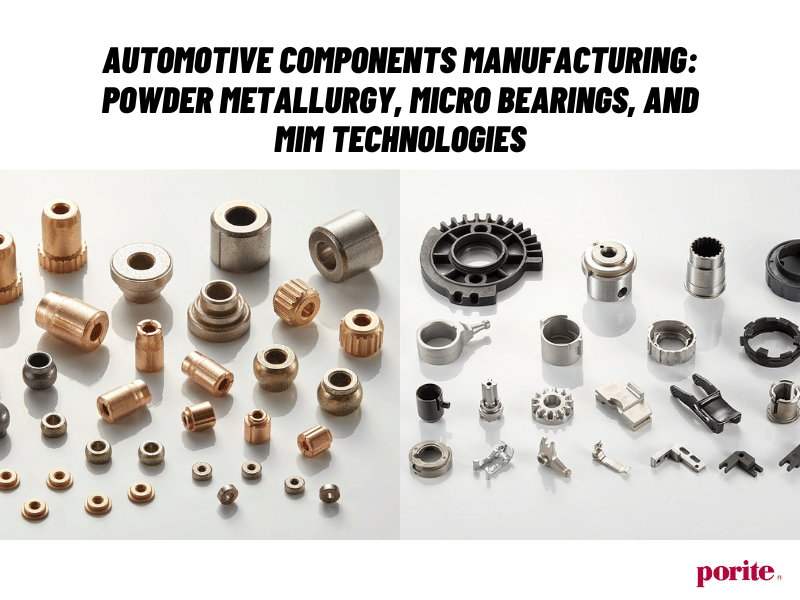
Automotive Components Manufacturing: Powder Metallurgy, Micro Bearings, and MIM Technologies
Introduction
The automotive industry is undergoing rapid transformation. Electrification, vehicle automation, and increasingly complex electronic systems are changing how vehicles are designed and manufactured. As a result, automotive manufacturers are seeking component suppliers that can deliver high precision, reliable performance, and cost-effective mass production.
Many of the critical components used in modern vehicles—from drivetrain gears to miniature motor bearings—require specialized manufacturing technologies. Among the most important are powder metallurgy, micro bearing manufacturing, and metal injection molding (MIM).
At Porite Taiwan, these three advanced manufacturing technologies provide complementary solutions for producing high-performance automotive components. Each process offers unique advantages that enable automakers to meet demanding requirements in durability, efficiency, and scalability.
The Growing Demand for Precision Automotive Components
Modern vehicles contain hundreds of mechanical components and dozens of electric motors. In electric vehicles (EVs) and hybrid systems, the number of precision components is even greater.
Key automotive design trends driving demand for advanced manufacturing technologies include:
- Vehicle electrification – electric motors, cooling systems, and power electronics
- Lightweight design – improving fuel efficiency and vehicle range
- High reliability – components must perform consistently for long lifecycles
- Large-scale production – millions of vehicles require consistent component quality
To address these challenges, automotive manufacturers rely on metal manufacturing processes that offer both precision engineering and high-volume production capability.
1. Powder Metallurgy: A Core Technology for Automotive Components
Powder metallurgy (PM) is one of the most widely used manufacturing methods in the automotive industry. The process involves compacting metal powder into a desired shape and then sintering it at high temperature to create a strong and durable component.
Advantages of Powder Metallurgy
Powder metallurgy offers several advantages for automotive applications:
- Near-net-shape manufacturing, minimizing secondary machining
- High material utilization, reducing waste
- Excellent dimensional consistency for mass production
- Strong mechanical properties and wear resistance
- Cost efficiency in large production volumes
Because PM components can be formed close to their final geometry, manufacturers can significantly reduce machining operations and production costs.
Typical Automotive Parts Produced by Powder Metallurgy
Powder metallurgy is commonly used to manufacture:
- Transmission gears
- Oil pump rotors
- Camshaft sprockets
- Valve train components
- Structural parts for electric motors
PM technology is particularly suitable for drivetrain components and mechanical assemblies that require both strength and precision.
2. Micro Bearing Manufacturing for Automotive Motors
Modern vehicles rely on a large number of small electric motors for various functions. These motors require compact bearings capable of operating reliably under continuous motion and variable loads.
Advantages of Micro Bearing Technology
Micro bearings provide several key benefits:
- High rotational precision
- Low friction performance
- Long service life
- Stable operation in compact mechanical systems
Many automotive bearings produced through powder metallurgy also feature self-lubricating properties, which allow them to operate efficiently without frequent maintenance.
Automotive Applications for Micro Bearings
Micro bearings are widely used in:
- Power window motors
- Electric seat adjustment systems
- Cooling fan motors
- Headlight adjustment motors
- Sensor modules and actuator systems
As vehicles integrate more electric systems, the demand for high-precision miniature bearings continues to grow.
3. Metal Injection Molding (MIM) for Complex Automotive Parts
Metal Injection Molding (MIM) combines the design flexibility of plastic injection molding with the material performance of metal. This technology is ideal for producing small, complex metal components that would otherwise require extensive machining.
Advantages of MIM Technology
MIM offers several advantages for automotive applications:
- Capability to produce highly complex geometries
- Excellent dimensional accuracy
- High-density metal properties
- Efficient mass production of small parts
This makes MIM particularly suitable for components that require precision, strength, and intricate shapes.
Automotive Components Produced Using MIM
Typical automotive applications include:
- Safety system components
- Seat belt locking mechanisms
- Sensor housings
- Small transmission components
- Electronic connector parts
MIM enables engineers to design parts that would be difficult or costly to produce using traditional machining methods.
Integrated Manufacturing Capabilities for Automotive Solutions
Each of these manufacturing technologies serves different types of automotive components:
| Technology | Typical Automotive Components | Key Advantages |
|---|---|---|
| Powder Metallurgy | Gears, pump rotors, structural components | Cost-effective mass production |
| Micro Bearings | Motor bearings for automotive electronics | Low friction and long lifespan |
| Metal Injection Molding | Small complex mechanical parts | High precision and design flexibility |
By integrating these technologies, Porite Taiwan provides a comprehensive manufacturing platform capable of supporting a wide range of automotive applications.
The Future of Automotive Component Manufacturing
As vehicles continue to evolve toward electrification, automation, and intelligent mobility, the demand for precision metal components will continue to increase.
Electric vehicles alone require a larger number of motors, sensors, and mechanical actuators compared to traditional vehicles. This trend is driving demand for manufacturing technologies that can deliver:
- High dimensional precision
- Consistent quality in large volumes
- Efficient material utilization
- Reliable long-term performance
Manufacturers that combine multiple metal processing technologies—such as powder metallurgy, micro bearing production, and metal injection molding—are well positioned to support the next generation of automotive innovation.
Conclusion
Automotive manufacturers rely on advanced manufacturing technologies to produce the precision components that power modern vehicles.
Through its expertise in powder metallurgy, micro bearing manufacturing, and metal injection molding, Porite Taiwan supports the automotive industry with reliable, high-performance metal components designed for demanding applications.
As the automotive sector continues to evolve, these manufacturing technologies will remain essential for enabling the next generation of efficient, durable, and intelligent vehicles.