
News Release
Media
Gearbox Design for Automation Equipment: Key Factors in Precision, Durability, and Efficiency
Introduction
As industrial automation continues to advance, gearbox performance has become increasingly critical in modern motion systems. From robotic arms and AGVs to packaging machinery and smart manufacturing equipment, gearboxes play a central role in converting motor output into controlled, efficient mechanical motion.
For automation equipment manufacturers, selecting or designing the right gearbox is no longer just about torque reduction—it requires careful consideration of precision, durability, and efficiency to meet the demands of increasingly sophisticated systems.
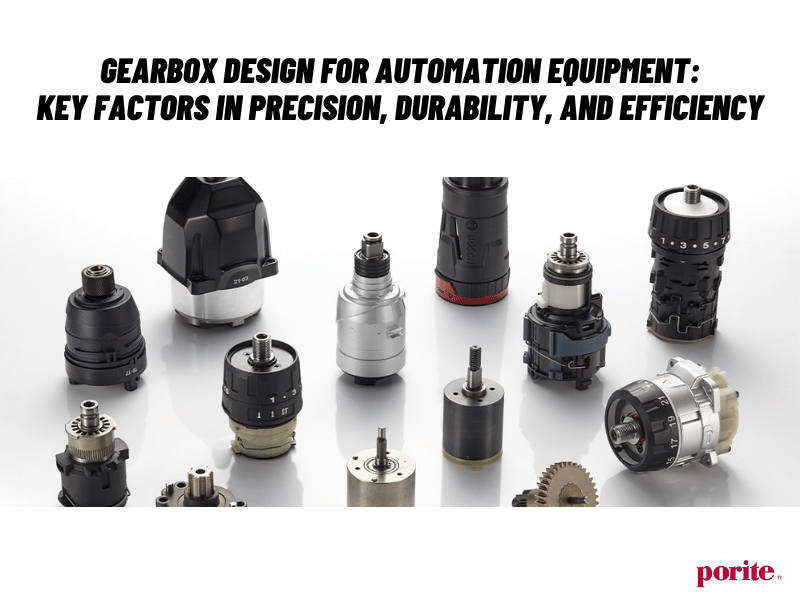
At Porite Taiwan, our gearbox assembly expertise supports automation and industrial equipment manufacturers with integrated gearbox solutions engineered for reliable long-term performance.
Why Gearboxes Matter in Automation Equipment
Gearboxes are essential mechanical transmission components that adjust motor speed and torque to match application requirements. In automation systems, they help optimize the relationship between electric motors and driven mechanisms.
Typical gearbox functions include:
- Reducing motor speed for controlled output
- Increasing torque for load handling
- Improving motion control precision
- Matching motor characteristics to application needs
Automation equipment that commonly relies on gearbox assemblies includes:
- Robotic arms
- Automated guided vehicles (AGVs) / autonomous mobile robots (AMRs)
- Conveyor systems
- Packaging and labeling machines
- CNC and machine tool automation systems
As automation equipment becomes more compact and precise, gearbox design requirements continue to increase.
Precision: Why Accuracy Matters in Automation Gearboxes
Precision is one of the most important factors in gearbox design for automation applications. In systems requiring repeatable positioning and smooth motion control, even minor gearbox inaccuracies can reduce machine performance.
Key Precision Factors Include:
- Backlash Control
Excessive backlash reduces positioning accuracy and repeatability, especially in robotic or servo-driven systems. - Gear Tooth Accuracy
Precise tooth geometry ensures smooth meshing and consistent torque transmission. - Assembly Tolerance Control
Proper alignment of shafts, bearings, and gears is essential for minimizing vibration and maintaining performance. - Dimensional Consistency
Tight manufacturing tolerances ensure every gearbox performs consistently across production batches.
For applications such as robotic joints or automated assembly systems, gearbox precision directly impacts system stability and product quality.
Durability: Engineering for Long-Term Reliability
Automation equipment often operates continuously for extended periods, making gearbox durability a critical design consideration.
Key Durability Factors Include:
- Material Selection
Gear and housing materials must provide adequate strength, wear resistance, and fatigue life. - Heat Treatment and Surface Hardening
Proper hardening processes improve gear tooth durability under repeated load cycles. - Bearing Support Design
Bearings must maintain shaft alignment under dynamic loads. - Lubrication Management
Proper lubrication reduces friction and wear while extending service life. - Thermal Stability
Gearboxes operating in compact machinery may experience elevated temperatures, requiring stable materials and lubrication systems.
A durable gearbox reduces maintenance frequency, minimizes downtime, and lowers total cost of ownership for end users.
Efficiency: Reducing Energy Loss in Motion Systems
In automated manufacturing environments, energy efficiency is becoming increasingly important. Inefficient gearbox designs waste energy through friction, heat, and vibration.
Design Factors Affecting Gearbox Efficiency:
- Optimized Gear Tooth Profiles
Reduces sliding friction during meshing. - Low-Friction Bearing Systems
Minimizes rotational resistance. - Precision Gear Alignment
Prevents unnecessary internal loading and friction. - Efficient Lubrication Design
Ensures consistent lubrication while minimizing drag.
High-efficiency gearboxes improve overall system performance while helping manufacturers reduce energy consumption and operating costs.
Why Integrated Gearbox Assembly Expertise Matters
Designing a high-performance gearbox requires more than just quality gears—it requires expertise in component manufacturing, precision assembly, and system integration.
At Porite Taiwan, we provide integrated gearbox assembly solutions supported by our advanced manufacturing capabilities, including:
- Powder Metallurgy Gear Production for cost-effective, high-precision gear components
- Micro Bearing Manufacturing for compact rotating systems
- Metal Injection Molding (MIM) for complex precision parts
- Complete Gearbox Assembly and Integration for streamlined customer development
By combining component manufacturing and assembly under one roof, Porite Taiwan offers:
- Better dimensional consistency
- Faster development cycles
- Improved quality control
- Optimized gearbox performance through integrated engineering
Gearbox Applications Beyond Traditional Power Tools
While gearbox assemblies have long been used in power tools and automotive systems, their role is rapidly expanding into new automation sectors.
Emerging gearbox applications include:
- Collaborative robots (Cobots)
- Warehouse automation systems
- Smart factory machinery
- Medical automation equipment
- Service robotics
As these industries continue to grow, demand for compact, precise, and durable gearbox assemblies will only increase.
Conclusion
Gearbox design plays a vital role in the performance of automation equipment. Whether the goal is precise motion control, long-term durability, or improved system efficiency, gearbox engineering must address multiple factors simultaneously.
With expertise in gear manufacturing, bearing technology, precision metal forming, and integrated gearbox assembly, Porite Taiwan helps automation equipment manufacturers develop gearbox solutions that meet the demands of modern industrial applications.
As automation systems become more advanced, choosing the right gearbox manufacturing partner will be critical to achieving reliable, efficient, and scalable machine performance.