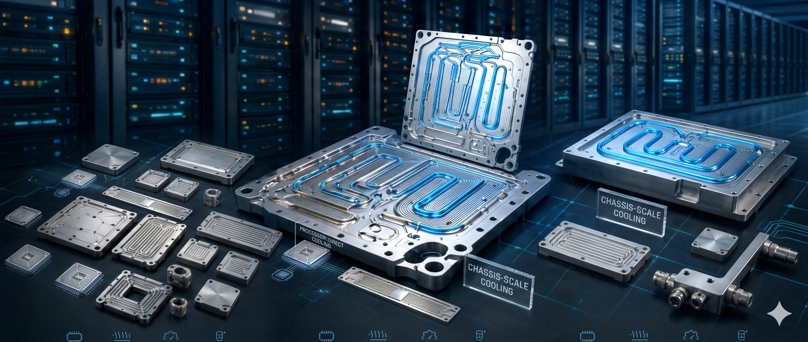
Introduction
As computing power continues to increase across AI servers, data centers, power electronics, and electric vehicles, thermal management has become a critical engineering challenge. Traditional air-cooling solutions are approaching their performance limits, accelerating the adoption of liquid cooling technologies capable of handling significantly higher heat loads.
Growing Demand for Advanced Thermal Management
The rapid expansion of artificial intelligence, high-performance computing (HPC), and cloud infrastructure is driving unprecedented increases in power density. Efficient heat dissipation is now essential for maintaining system reliability, performance, and energy efficiency.
Compared with conventional air cooling, liquid cooling systems offer several advantages:
-
Higher heat transfer efficiency
-
Improved temperature uniformity
-
Reduced energy consumption
-
Lower noise levels
-
More compact system design
As a result, liquid cooling solutions are increasingly being adopted in AI servers, data centers, power electronics, battery systems, telecommunications equipment, and industrial automation applications.
Powder Metallurgy Cooling Plates for Liquid Cooling Systems
Cooling plates are among the most critical components in liquid cooling systems, serving as the interface that transfers heat from electronic devices to the circulating coolant.
Porite is developing stainless steel cooling plates utilizing Powder Metallurgy (PM) technology. Compared with conventional manufacturing methods, PM offers excellent dimensional consistency, efficient material utilization, and cost-effective scalability for high-volume production.
In addition, Powder Metallurgy enables innovative design possibilities that may support optimized coolant flow paths and improved thermal performance, helping meet the growing requirements of next-generation cooling systems.
MIM Heat Sinks for Compact and High-Power Applications
As electronic devices continue to become smaller and more powerful, heat sinks must provide greater cooling capacity within increasingly limited installation space.
Metal Injection Molding (MIM) technology combines the design flexibility of injection molding with the strength and durability of metal materials. This manufacturing process enables the production of heat sinks with complex fin geometries and intricate structures that are difficult to achieve through traditional machining methods.
MIM heat sinks can maximize heat-transfer surface area while maintaining excellent dimensional accuracy and production efficiency, making them suitable for advanced electronics, power modules, communication systems, and other thermal management applications.
Supporting the Future of Thermal Management
The growth of AI computing, electrification, and digital infrastructure continues to create new challenges for thermal management. As power densities increase, advanced cooling solutions will become increasingly important across multiple industries.
By leveraging both Powder Metallurgy and Metal Injection Molding technologies, Porite is expanding its capabilities beyond traditional mechanical components and supporting customers in developing innovative thermal management solutions for next-generation applications.
Through continuous innovation and manufacturing expertise, Porite remains committed to delivering reliable metal components that contribute to efficient heat dissipation, improved system performance, and sustainable technological advancement.