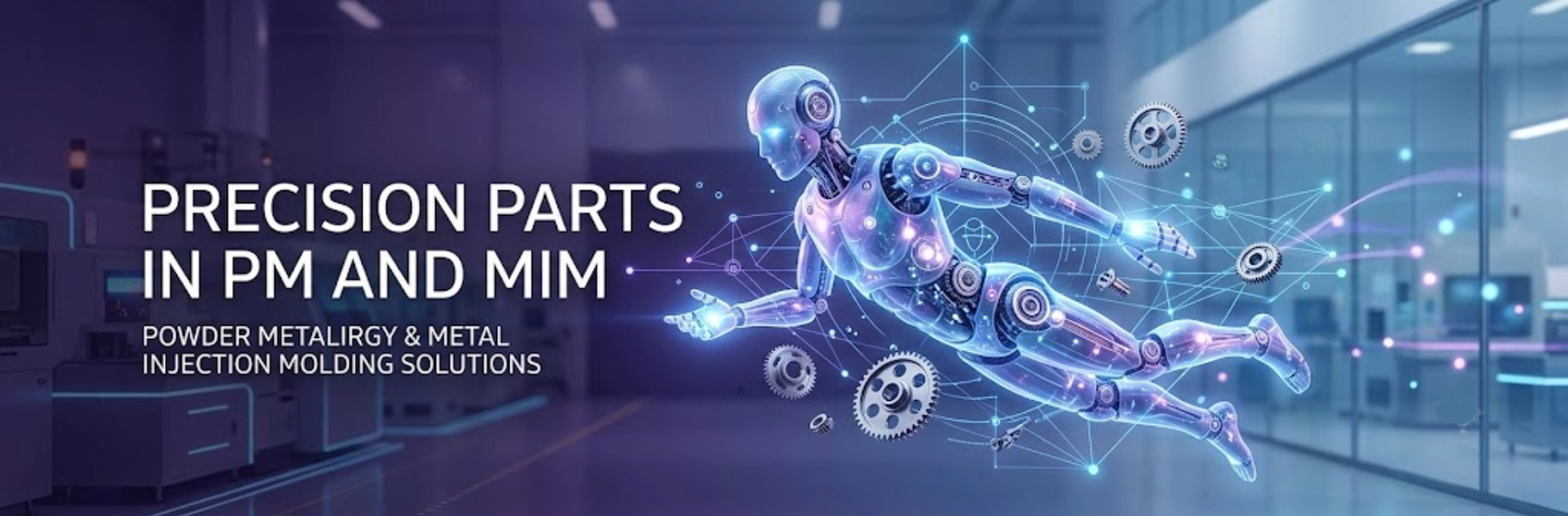
Introduction
Growing Demand for Advanced Robotic Systems
Modern robotic systems require precise motion control, efficient power transmission, and stable mechanical structures to perform increasingly complex tasks. From robotic joints and actuators to drive systems and reduction mechanisms, every component directly impacts positioning accuracy, operational efficiency, and service life.
Several key trends are driving the continued growth of the robotics industry:
• Expansion of industrial automation and smart factories
• Increasing demand for service robots and collaborative robots (cobots)
• Rapid development of AI-powered intelligent robotics
• Continued growth of logistics and warehouse automation
• Emerging opportunities in humanoid robotics
As robotic applications continue to diversify, demand is increasing for components that offer high precision, consistency, and scalable production capabilities to meet the performance requirements of next-generation robotic systems.
Powder Metallurgy Components for Robotic Transmission Systems
Powder Metallurgy (PM) technology is widely used to manufacture precision gears, oil-impregnated bearings, and various transmission components for robotic applications.
Compared with conventional machining processes, PM offers excellent dimensional consistency, high material utilization, and cost-effective mass production capabilities. In addition, PM technology enables the production of complex geometries while maintaining the precise dimensional control required by robotic systems.
These advantages help improve power transmission efficiency, reduce component weight, and enhance overall system stability and reliability, supporting the performance requirements of a wide range of robotic applications.
MIM Components for Miniaturization and High-Precision Applications
As robots continue to evolve toward greater miniaturization, higher functional integration, and lighter weight designs, demand is increasing for metal components that combine high strength with complex geometries.
Metal Injection Molding (MIM) technology combines the design flexibility of injection molding with the mechanical properties of metal materials. This process enables the production of intricate and highly complex components that would be difficult to achieve through conventional manufacturing methods.
MIM technology is particularly suitable for robotic joint components, actuator parts, sensor housings, precision structural components, and other space-constrained applications, helping enhance design flexibility and overall product performance.
Supporting the Future of Robotics
The continued advancement of artificial intelligence, automation, and smart manufacturing is expected to further accelerate the growth of the global robotics industry. As robots become increasingly integrated into industrial operations and everyday life, the importance of high-quality precision metal components will continue to grow.
By leveraging both Powder Metallurgy and Metal Injection Molding technologies, Porite continues to provide innovative component solutions that help robotic manufacturers meet evolving technological demands.
With decades of PM and MIM manufacturing experience and a commitment to continuous innovation, Porite delivers reliable, high-performance, and mass-producible metal components that help customers improve robotic performance, production efficiency, and market competitiveness.
If you have related requirements or project inquiries, please contact us.