
News Release
Media
PM vs. HPM vs. MIM vs. CNC Machining: Which Manufacturing Process Is Best for Robot Components?
The rapid growth of industrial automation is driving unprecedented demand for high-performance robot components. According to the International Federation of Robotics (IFR), more than 542,000 industrial robots were installed worldwide in 2024, marking the fourth consecutive year that annual installations exceeded half a million units.
The global operational stock of industrial robots has now surpassed 4.6 million units, reflecting the continued expansion of automation across manufacturing, logistics, healthcare, electronics, and other industries.
As collaborative robots, autonomous mobile robots, AI-powered automation systems, and humanoid robots become more common, manufacturers face increasing pressure to produce components that are lightweight, durable, precise, and cost-effective. Choosing the right manufacturing process has therefore become just as important as selecting the right material.
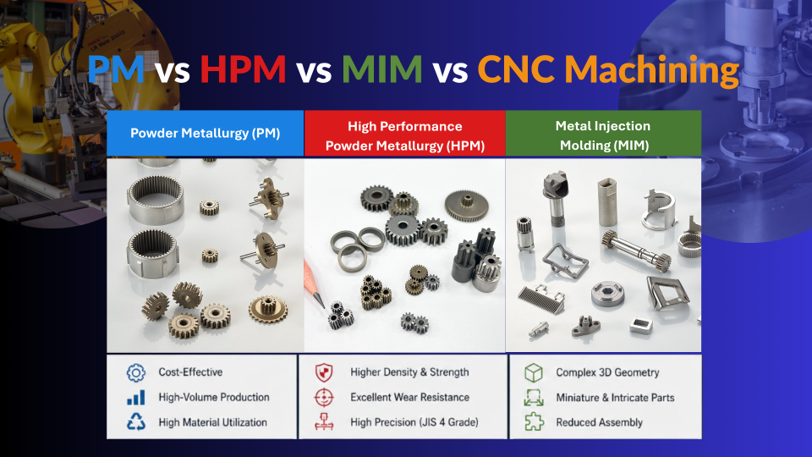
Among the available manufacturing technologies, CNC machining, conventional Powder Metallurgy (PM), High Density and High Performance Powder Metallurgy (HPM), and Metal Injection Molding (MIM) each offer distinct advantages for different robot components.
Common Manufacturing Processes for Robot Components
Modern robots are rarely built using a single manufacturing process. Manufacturers combine different technologies according to each component’s function, geometry, mechanical requirements, production volume, size, and cost target.
| Manufacturing Process | Typical Robot Components | Primary Advantage |
|---|---|---|
| CNC Machining | Joint housings, shafts, structural frames, prototypes | Design flexibility and high accuracy |
| Powder Metallurgy (PM) | Standard gears, bearings, bushings, and sprockets | Cost-effective high-volume production |
| High Performance Powder Metallurgy (HPM) | High-load gears, precision small gears, and actuator parts | Higher density, strength, and precision than conventional PM |
| Metal Injection Molding (MIM) | Locking mechanisms, sensor parts, connectors, complex miniature parts | Complex three-dimensional geometry |
| Die Casting | Aluminum housings and motor cases | Efficient production of larger lightweight housings |
| Plastic Injection Molding | Covers, cable guides, and connectors | Lightweight and economical non-metal parts |
Each process fills a different role within a robot’s mechanical system. The objective is not to identify one process that is universally superior, but to match each component with the manufacturing method that offers the best balance of performance, scalability, and cost.
CNC Machining: Ideal for Prototypes and Large Structural Parts
CNC machining remains one of the most versatile manufacturing methods for robotic components. Material is removed from a solid workpiece using controlled machining operations, allowing manufacturers to achieve tight tolerances and modify designs without investing in dedicated forming tools.
CNC machining is particularly suitable for:
- Prototype development
- Low-volume production
- Large structural components
- Robot arm and joint housings
- Precision shafts
- Custom mechanical assemblies
- Components requiring frequent design changes
CNC machining is valuable during early product development because engineers can revise component designs without replacing expensive molds or compaction tooling. It is therefore commonly used for robot start-ups, customized automation equipment, research projects, and pilot-production programs.
However, CNC machining can become less economical as production volume increases. Material waste, longer cycle times, multiple machining operations, tool wear, and labor requirements may significantly increase the unit cost of mass-produced components.
Many robot manufacturers therefore begin with CNC machining during the prototype stage and later transition suitable parts to PM, HPM, or MIM once the design has stabilized and production volumes increase.
Powder Metallurgy: Optimized for High-Volume Mechanical Components
Powder Metallurgy is widely used for robot components that require dimensional consistency, efficient material utilization, repeatable production, and competitive unit costs.
Instead of cutting a component from a solid metal block, the PM process compacts metal powder into a desired shape and then sinters it under controlled conditions. This enables near-net-shape production while reducing material waste and secondary machining.
Typical robot components produced using conventional PM include:
- Spur gears
- Planetary gears
- Timing gears
- Oil-impregnated bearings
- Bushings
- Sprockets
- Transmission components
- Standard actuator parts
These components may be found in robotic joints, gearboxes, motors, actuators, reduction mechanisms, and motion-control systems.
Compared with CNC machining, conventional Powder Metallurgy offers several advantages:
- High material utilization: Near-net-shape production minimizes chips and material loss.
- Consistent repeatability: Controlled tooling supports stable part-to-part dimensions.
- Reduced secondary machining: Many geometric features can be formed during compaction.
- Competitive unit costs: Tooling investment can be distributed across large production quantities.
- Functional material properties: PM can support porous, self-lubricating, and wear-resistant components.
For robot manufacturers seeking a practical balance between mechanical performance and mass-production efficiency, conventional PM remains an effective solution for standard gears, bushings, bearings, and other repetitive drivetrain components.
Learn more about Porite’s robotics applications.
High Performance Powder Metallurgy: When Conventional PM Is Not Enough
High Density and High Performance Powder Metallurgy (HPM) is an advanced powder metallurgy process developed for components that require greater density, strength, precision, and wear resistance than conventional PM parts can typically provide.
HPM retains many of the benefits of traditional Powder Metallurgy, including near-net-shape manufacturing, efficient material utilization, production repeatability, and scalability. However, optimized powder materials and manufacturing conditions allow HPM parts to achieve substantially improved mechanical properties.
According to Porite’s HPM capabilities, the process can increase part density from approximately 7.1 g/cm³ to 7.6 g/cm³ and improve strength by more than 60% compared with conventional PM components.
HPM can therefore help bridge the performance gap between conventional PM and other manufacturing methods such as CNC machining, forging, casting, and MIM.
Potential HPM applications in robotic systems include:
- High-load planetary gears
- Precision small gears
- Robot joint transmission components
- Actuator gears and drivetrain parts
- Wear-resistant sprockets
- Compact structural components
- Electric motor components
- Gearbox components
HPM may be considered when a conventional PM part cannot provide sufficient strength, density, tooth durability, hardness, or dimensional precision, but the project still requires the material efficiency and production scalability of Powder Metallurgy.
Porite’s HPM process is particularly suited to small gears and metal parts smaller than Φ30 × 30 × 15 mm and weighing less than 30 grams. This makes it relevant to compact robot joints, small actuators, motor-driven mechanisms, and precision transmission systems.
Compared with conventional PM, HPM can provide:
- Higher part density
- Improved tensile and tooth-breakage strength
- Greater hardness and wear resistance
- Better dimensional precision
- Longer service life under repeated mechanical loads
Compared with MIM, HPM may offer improved cost efficiency for suitable compact components. Compared with forging, casting, and subsequent machining, it can reduce material use and processing steps.
Learn more about Porite’s High Density & High Performance Powder Metallurgy.
Metal Injection Molding: Designed for Small and Complex Precision Parts
While conventional PM and HPM are effective for compact mechanical components, Metal Injection Molding addresses a different range of design challenges.
MIM combines fine metal powders with injection-molding technology. The feedstock is molded into a complex shape before undergoing debinding and sintering. This makes it possible to manufacture intricate three-dimensional metal parts that would be difficult or costly to produce using conventional machining or traditional PM compaction.
Robot manufacturers may consider MIM for:
- Locking mechanisms
- Sensor housings
- Connector components
- Precision actuator parts
- Compact structural components
- Parts with thin walls or integrated features
MIM is particularly valuable when components require:
- Complex three-dimensional geometry
- Thin-wall structures
- Small overall dimensions
- Integrated functions
- Reduced assembly requirements
- Medium- to high-volume production
Although MIM requires a higher initial tooling investment than CNC machining, it may become cost-effective when production volumes justify the tooling and when one molded component can replace several machined or assembled parts.
MIM should not be viewed as a replacement for every PM or HPM component. Conventional PM is suited to economical mechanical parts, HPM provides enhanced performance for compact precision parts, and MIM offers greater design freedom for intricate three-dimensional geometries.
PM vs. HPM vs. MIM vs. CNC Machining
No single manufacturing method is ideal for every robot component. The correct selection depends on part size, geometry, mechanical loading, tolerances, production volume, material requirements, expected service life, and total manufacturing cost.
| Comparison | CNC Machining | Powder Metallurgy (PM) | High Performance PM (HPM) | Metal Injection Molding (MIM) |
|---|---|---|---|---|
| Production Volume | Low to medium | High | Medium to high | Medium to high |
| Part Size | Small to large | Small to medium | Primarily compact parts and small gears | Primarily small parts |
| Part Complexity | Moderate to high, depending on tool access | Moderate | Moderate; particularly suitable for precision gears | Excellent for complex 3D geometries |
| Dimensional Accuracy | Excellent | Good | High for suitable compact components | Good to excellent, depending on geometry and shrinkage control |
| Mechanical Performance | Excellent, depending on material | Suitable for standard mechanical applications | Higher density and strength than conventional PM | High performance for suitable small parts |
| Material Utilization | Lower because material is removed | Very high | Very high | Very high |
| Initial Tooling Investment | Relatively low | Higher | Higher, depending on process requirements | Higher |
| Design Changes | Relatively easy to implement | May require tooling modification | May require tooling and process modification | May require tooling modification |
| Typical Robot Components | Frames, shafts, housings, and prototypes | Standard gears, bearings, bushings, and sprockets | High-load gears, precision small gears, and actuator components | Locks, connectors, sensor parts, and intricate miniature components |
These manufacturing technologies often complement rather than directly replace one another. A robot may contain CNC-machined structural housings, conventional PM bearings, HPM drivetrain gears, and MIM locking or sensor components within the same system.
Which Process Fits Different Robot Components?
| Robot Component | Recommended Process | Main Reason |
|---|---|---|
| Standard spur gear | Powder Metallurgy | Repeatable and economical high-volume production |
| Oil-impregnated bearing | Powder Metallurgy | Supports a porous, self-lubricating structure |
| High-load compact planetary gear | High Performance Powder Metallurgy | Higher density, strength, and tooth durability than conventional PM |
| Precision small actuator gear | High Performance Powder Metallurgy | Combines precision with scalable Powder Metallurgy production |
| Miniature locking component | Metal Injection Molding | Complex three-dimensional geometry and compact size |
| Sensor housing | Metal Injection Molding | Thin walls and integrated geometric features |
| Robot joint housing | CNC Machining or Die Casting | Larger structural dimensions and precise mounting features |
| Prototype shaft | CNC Machining | Low tooling investment and easy design modification |
How to Choose the Right Manufacturing Process
Process selection should begin with the functional and commercial requirements of the component rather than a preference for one technology.
Choose CNC Machining When Your Project Requires:
- Prototype development or frequent design changes
- Low production quantities
- Large structural components
- Precision shafts or mounting surfaces
- Short development lead times without dedicated forming tools
Choose Powder Metallurgy When Your Project Requires:
- High-volume production
- Standard mechanical components
- Near-net-shape manufacturing
- High material utilization
- Reduced secondary machining
- Competitive unit costs at scale
- Self-lubricating bearings or bushings
Choose High Performance Powder Metallurgy When Your Project Requires:
- Higher density and strength than conventional PM
- Compact, high-load transmission components
- Precision small gears for robot joints or actuators
- Improved tooth strength, hardness, and wear resistance
- Reliable performance under repeated mechanical loads
- Medium- to high-volume production
- A cost-efficient alternative to forging, casting, or extensive machining
Choose Metal Injection Molding When Your Project Requires:
- Small and intricate metal components
- Complex three-dimensional geometry
- Thin-wall or integrated designs
- Reduced part count and assembly requirements
- Medium- to high-volume production
Production volume alone should not determine the final choice. Engineers should also evaluate mechanical loading, fatigue requirements, density, part dimensions, surface finish, tolerances, tooling cost, post-processing, and expected product life.
For many robot manufacturers, the most effective solution is a hybrid manufacturing strategy. Structural housings may be CNC machined or die cast, standard drivetrain components may use conventional PM, compact high-load gears may use HPM, and intricate miniature components may be manufactured using MIM.
How Porite Supports Robot Component Manufacturing
As robots become lighter, smarter, more compact, and more widely produced, component manufacturers must provide higher precision and mechanical performance while maintaining production efficiency and cost competitiveness.
Porite supports robotic component development through multiple manufacturing technologies, including Powder Metallurgy, High Density and High Performance Powder Metallurgy, and Metal Injection Molding.
By working with customers during the design and development stages, Porite can help evaluate suitable manufacturing solutions according to:
- Component geometry and dimensions
- Mechanical and functional requirements
- Density and strength targets
- Material selection
- Expected production volume
- Tolerance and surface requirements
- Tooling and unit-cost targets
This engineering-focused approach helps robot manufacturers determine whether a part is better suited to conventional PM, HPM, MIM, CNC machining, or a combination of manufacturing methods.
For robotics applications, Porite supports the development of gears, bushings, bearings, transmission parts, actuator components, structural components, and customized metal parts for modern motion-control and automation systems.
Explore Porite’s robotics component applications.
Choosing Manufacturing Technologies for Future Robotics
The continued development of collaborative robots, autonomous mobile robots, AI-powered automation systems, and humanoid robots is creating new challenges for component designers. Future robotic systems will increasingly require parts that are smaller, lighter, stronger, more durable, and easier to manufacture at scale.
CNC machining, conventional PM, HPM, and MIM will each remain important. The key is not determining which technology is universally best, but identifying which process offers the most appropriate balance of design flexibility, mechanical performance, production volume, and total cost for each component.
By evaluating manufacturability early in the design stage, robot manufacturers can reduce unnecessary machining, avoid unsuitable tooling investments, improve component consistency, and support a smoother transition from prototype development to mass production.
Frequently Asked Questions
What Is the Difference Between Conventional PM and HPM?
Conventional Powder Metallurgy is commonly used for cost-effective, high-volume production of gears, bearings, bushings, sprockets, and structural parts. High Performance Powder Metallurgy builds on the conventional PM process to achieve greater density, strength, hardness, wear resistance, and precision. HPM is therefore suitable for demanding compact gears and drivetrain components where conventional PM performance may not be sufficient.
Can HPM Replace CNC Machining?
HPM can replace CNC-machined, forged, or cast components in selected applications when the part size, geometry, material, tolerance, and production volume are suitable. CNC machining remains more appropriate for prototypes, large parts, low production quantities, and designs that change frequently.
What Is the Difference Between PM, HPM, and MIM?
Conventional PM is generally used for economical high-volume mechanical components. HPM provides improved density and mechanical performance for suitable compact gears and metal parts. MIM is more suitable for small components with complex three-dimensional shapes, thin walls, and integrated geometric features.
Is Powder Metallurgy More Cost-Effective Than CNC Machining?
For stable, high-volume production, Powder Metallurgy can provide a lower unit cost because it minimizes material waste and reduces machining operations. CNC machining is generally more suitable for prototypes, larger structural parts, and lower-volume production.
Which Robot Components May Benefit From HPM?
Potential applications include compact high-load gears, precision small gears, actuator transmission components, motor parts, gearbox components, wear-resistant sprockets, and robot joint drivetrain parts.
Can One Robot Use Multiple Manufacturing Processes?
Yes. Most robots combine several manufacturing technologies. A robot may use CNC-machined housings, conventional PM bearings and bushings, HPM precision gears, MIM locking mechanisms, die-cast motor cases, and injection-molded plastic covers.
Continue Reading
- Why Powder Metallurgy Is Ideal for High-Volume Robot Components (Coming Soon)
- When Should Robot Manufacturers Choose MIM Instead of CNC Machining? (Coming Soon)
Ready to Optimize Your Robot Components?
Whether you are developing industrial robots, collaborative robots, autonomous mobile robots, humanoid robots, or precision automation equipment, selecting the right manufacturing process is essential to balancing performance, quality, scalability, and production cost.
Porite provides customized PM, HPM, and MIM solutions to help manufacturers evaluate component geometry, material requirements, mechanical performance, production volume, and scalable manufacturing options.