
News Release
Media
Powder Metallurgy Bimetal Technology: A Composite Material Solution for Industrial Components
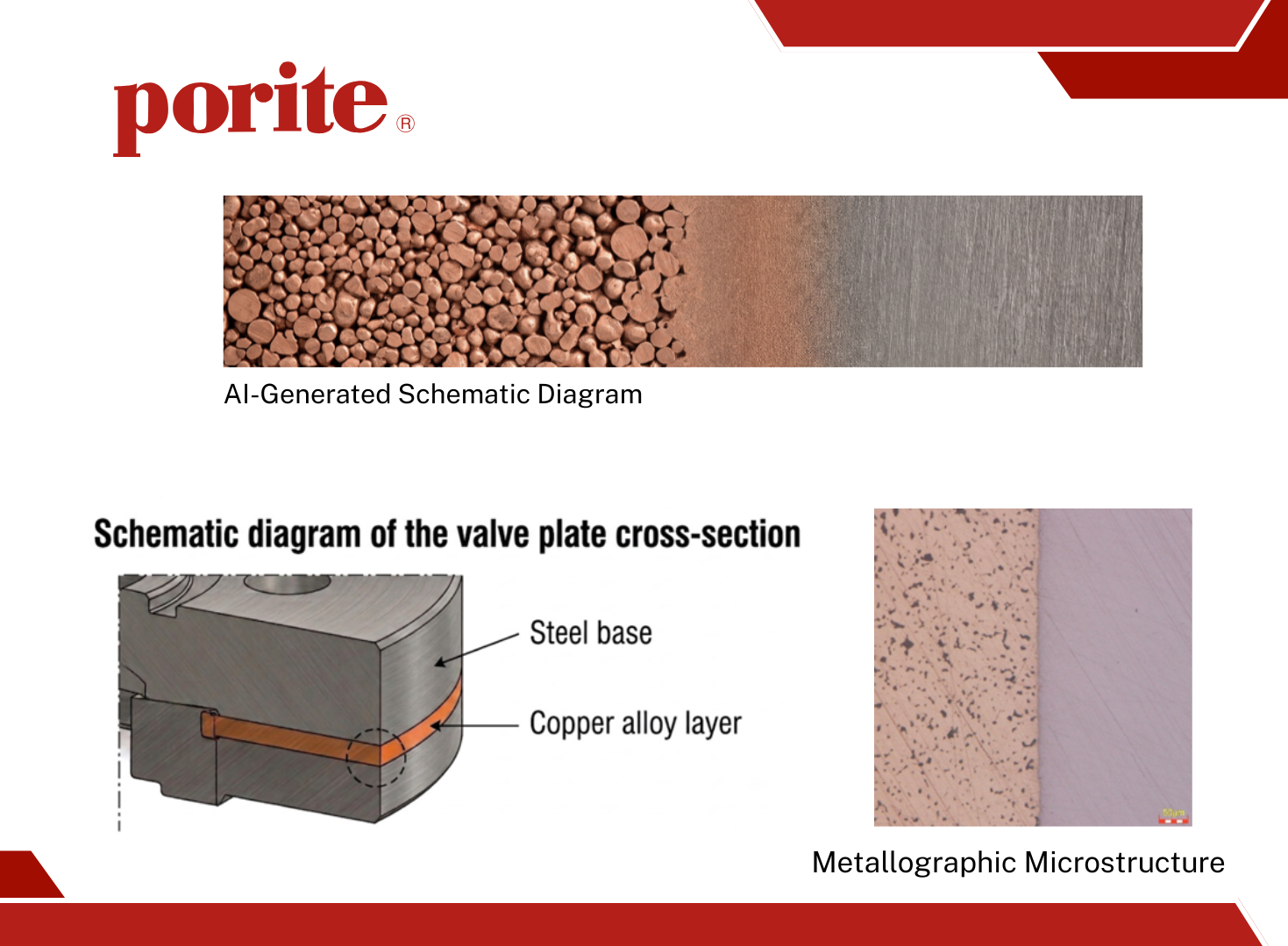
 (AI-Generated Schematic Diagram)
In industrial equipment design, specific components often face complex physical requirements. For example, the main structure requires high strength to withstand high loads, while the contact surface needs a low friction coefficient to reduce wear.
Traditional single metals struggle to simultaneously meet both conditions: high-hardness metals easily cause wear on counter parts during friction, whereas highly lubricious metals are prone to deformation under pressure. To address such needs, the industry commonly adopts a "bimetal" composite design, combining materials with two distinct properties. In this manufacturing process, powder metallurgy technology provides a viable alternative for mass production.
Characteristics of Powder Metallurgy in Bimetal Manufacturing:
- Flexibility in Material Composition Design: Traditional melting processes have difficulty handling metals with excessively large melting point differences or those that are immiscible. Powder metallurgy can uniformly mix specific solid lubricating phases (such as special metal particles) into the matrix powder. When the component is operating under poor local lubrication conditions, these particles can form a solid lubricating film on the surface, thereby reducing the risk of direct metal-to-metal friction and the incidence of galling.
- Enhancing the Utilization Efficiency of High-Value Materials: Through co-sintering technology, more expensive wear-resistant or lubricating alloy powders can be applied solely to the working surfaces where friction actually occurs, while the main body of the component utilizes conventional high-strength steel. This approach effectively reduces the overall consumption of special metals; simultaneously, the near net shape forming characteristics of powder metallurgy help decrease subsequent machining time and material waste.
Application Case: Axial Piston Pump Valve Plate:
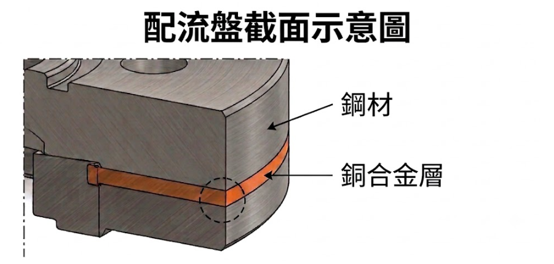
The axial piston pump is a common power component in hydraulic systems, within which the "valve plate" is responsible for oil distribution and dynamic sealing, requiring continuous sliding friction under high-pressure environments. Valve plates manufactured using bimetal technology utilize high-strength steel for the base layer to resist high-pressure deformation; the working surface is sintered with a specific copper alloy layer. This copper alloy layer possesses moderate microscopic elasticity, allowing it to conform to minor deformations of the counterpart and assist in maintaining the stability of the fluid dynamic oil film, thereby controlling mechanical friction loss while ensuring the sealing boundary.
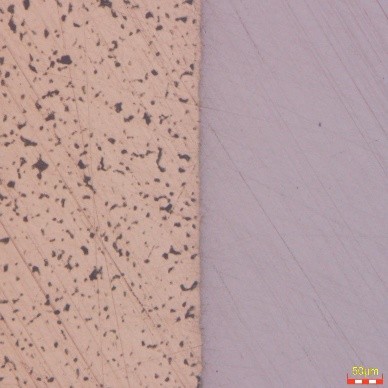 Metallographic Microstructure
Conclusion
In the face of industrial components with complex physical requirements, powder metallurgy bimetal technology provides a solution that balances material performance and manufacturing costs. By combining the physical advantages of different metals, this technology helps optimize the operational stability and economic efficiency of key components.