
新聞消息
媒體專區
PM vs. MIM vs. CNC Machining: Which Manufacturing Process Is Best for Robot Components?
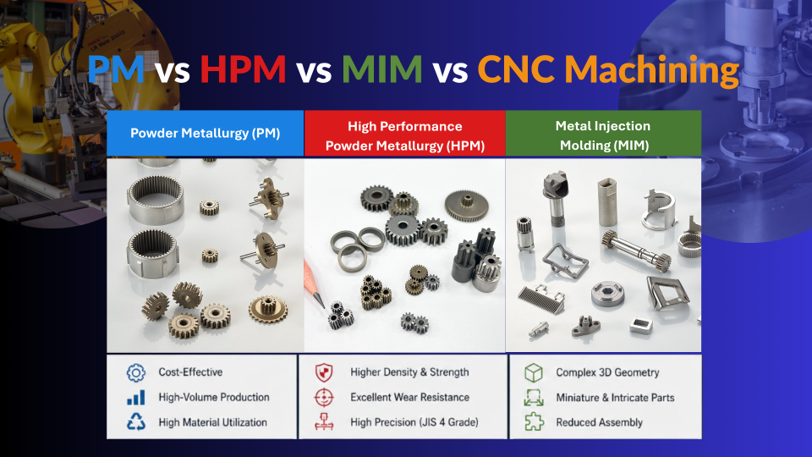
The rapid growth of industrial automation is driving unprecedented demand for high-performance robot components. According to the International Federation of Robotics (IFR), more than 542,000 industrial robots were installed worldwide in 2024, marking the fourth consecutive year that annual installations exceeded half a million units. The global operational stock of industrial robots has now surpassed 4.6 million units, reflecting the continued expansion of automation across manufacturing, logistics, healthcare, and electronics industries.
As collaborative robots, autonomous mobile robots, AI-powered automation systems, and humanoid robots become more common, robot manufacturers face increasing pressure to produce components that are lightweight, durable, highly precise, and cost-effective. Choosing the right manufacturing process has therefore become just as important as selecting the right material.
Among the most common manufacturing technologies, CNC machining, Powder Metallurgy (PM), and Metal Injection Molding (MIM) each offer distinct advantages. Understanding when to use each process can help manufacturers optimize component performance, production efficiency, and total manufacturing cost.
Common Manufacturing Processes for Robot Components
Modern robots are rarely built using a single manufacturing process. Instead, manufacturers combine different technologies based on each component’s function, geometry, material requirements, production volume, and cost targets.
| Manufacturing Process | Typical Robot Components |
|---|---|
| CNC Machining | Joint housings, shafts, structural frames |
| Powder Metallurgy (PM) | Gears, bearings, bushings, sprockets |
| Metal Injection Molding (MIM) | Locking mechanisms, sensor parts |
| Die Casting | Aluminum housings, motor cases |
| Plastic Injection Molding | Covers, cable guides, connectors |
Each process fills a different role within a robot’s mechanical system, making process selection a critical engineering decision.
CNC Machining: Ideal for Prototypes and Large Structural Parts
CNC machining remains one of the most versatile manufacturing methods for robotics. Because material is removed from a solid workpiece, CNC machining offers excellent dimensional accuracy and considerable flexibility without requiring dedicated high-volume tooling.
It is particularly suitable for:
- Prototype development
- Low-volume production
- Large structural components
- Robot arm and joint housings
- Precision shafts
- Custom mechanical assemblies
CNC machining is also useful during the early stages of product development because engineers can modify component designs without replacing expensive forming tools. This makes it suitable for robot start-ups, custom automation equipment, research projects, and applications with frequently changing specifications.
However, CNC machining becomes less economical as production volume increases. Material waste, longer cycle times, multiple machining operations, and higher labor requirements can significantly increase unit costs in mass production.
For this reason, many robot manufacturers use CNC machining during prototype and pilot-production stages, then transition suitable parts to PM or MIM once the design has stabilized and production volumes increase.
Powder Metallurgy: Optimized for High-Volume Mechanical Components
Powder Metallurgy is widely used for robot components that require dimensional consistency, high production efficiency, and competitive manufacturing costs.
Instead of cutting a component from a solid metal block, the PM process compacts metal powder into a desired shape and then sinters it under controlled conditions. This allows manufacturers to produce near-net-shape components while reducing material waste and secondary machining.
Typical robot components produced using PM include:
- Spur gears
- Planetary gears
- Timing gears
- Oil-impregnated bearings
- Bushings
- Sprockets
- Transmission and actuator components
These parts are commonly found in robotic joints, gearboxes, motors, actuators, and motion-control systems.
Compared with CNC machining, Powder Metallurgy offers several advantages for high-volume production:
- Excellent material utilization: Near-net-shape production minimizes chips and material loss.
- Consistent repeatability: Controlled tooling and processing support stable part-to-part quality.
- Reduced secondary machining: Many features can be formed directly during compaction.
- Lower unit costs at scale: Tooling costs can be distributed across large production quantities.
- Functional material options: PM can support self-lubricating, wear-resistant, and application-specific material properties.
For robot manufacturers seeking to balance mechanical performance with high-volume production efficiency, PM can be an effective choice for gears, bearings, bushings, and other repetitive drivetrain components.
Learn more about Porite’s robotics applications.
Metal Injection Molding: Designed for Small and Complex Precision Parts
While Powder Metallurgy excels at producing high-volume mechanical components, Metal Injection Molding addresses a different range of design and manufacturing challenges.
MIM combines fine metal powders with injection-molding technology. The material is molded into a complex shape before undergoing debinding and sintering processes. This enables manufacturers to produce intricate three-dimensional metal parts that would be difficult or costly to manufacture using conventional machining or traditional PM compaction.
Robot manufacturers may choose MIM for components such as:
- Locking mechanisms
- Sensor housings
- Connector components
- Precision actuator parts
- Compact structural components
MIM is particularly valuable when components require:
- Complex three-dimensional geometry
- Thin-wall structures
- Small overall dimensions
- Integrated features
- Reduced assembly requirements
- Medium- to high-volume production
Although MIM requires a higher initial tooling investment than CNC machining, it can become cost-effective when production volumes justify the tooling and when one molded component can replace several machined or assembled parts.
MIM should not be viewed simply as a more advanced version of PM. The two processes serve different component-design needs. Traditional PM is generally more suitable for relatively compact mechanical shapes and high-volume drivetrain parts, while MIM offers greater freedom for small, intricate, three-dimensional components.
PM vs. MIM vs. CNC Machining: A Side-by-Side Comparison
No single manufacturing method is ideal for every robot component. The right process depends on component size, geometry, tolerances, production volume, material requirements, and cost targets.
| Comparison | CNC Machining | Powder Metallurgy (PM) | Metal Injection Molding (MIM) |
|---|---|---|---|
| Production Volume | Low to medium | High | Medium to high |
| Part Complexity | Moderate to high, depending on tooling access | Moderate | Excellent for small 3D geometries |
| Dimensional Accuracy | Excellent | Good, with secondary finishing available | Good to excellent, depending on geometry and shrinkage control |
| Material Utilization | Lower because material is removed | Very high | Very high |
| Initial Tooling Investment | Relatively low | Higher | Higher |
| Unit Cost in Mass Production | Generally high | Generally low | Moderate, depending on complexity and volume |
| Design Changes | Easy to implement | May require tooling modification | May require tooling modification |
| Typical Robot Components | Frames, shafts, housings, prototypes | Gears, bearings, bushings, sprockets | Miniature gears, locks, connectors, sensor parts |
Rather than competing directly, these manufacturing technologies often complement one another. A single industrial robot may include CNC-machined structural components, PM gears and bearings, and MIM-produced locking or sensing components within the same assembly.
Real-World Examples: Which Process Fits Different Robot Components?
| Robot Component | Recommended Process | Main Reason |
|---|---|---|
| Planetary gear | Powder Metallurgy | Suitable for repeatable, high-volume gear production |
| Oil-impregnated bearing | Powder Metallurgy | Supports self-lubricating porous structures |
| Miniature locking component | Metal Injection Molding | Complex shape and compact size |
| Sensor housing | Metal Injection Molding | Thin walls and integrated geometric features |
| Robot joint housing | CNC Machining or Die Casting | Larger structural dimensions and precise mounting features |
| Prototype shaft | CNC Machining | Low tooling investment and easy design modification |
How to Choose the Right Manufacturing Process
Selecting the appropriate manufacturing process should begin with the component’s functional and commercial requirements rather than a preference for a particular technology.
Choose CNC Machining When Your Project Requires:
- Prototype development or frequent design changes
- Low production quantities
- Large structural components
- Tight tolerances on accessible machined features
- Short development lead times without dedicated forming tools
Choose Powder Metallurgy When Your Project Requires:
- High-volume production
- Repeatable mechanical components
- Near-net-shape manufacturing
- High material utilization
- Reduced secondary machining
- Competitive unit costs at scale
Choose Metal Injection Molding When Your Project Requires:
- Small and intricate metal components
- Complex three-dimensional geometry
- Thin-wall or integrated designs
- Reduced part count and assembly
- Medium- to high-volume production
Production volume alone should not determine the final choice. Engineers should also consider mechanical loading, fatigue requirements, density, surface finish, tolerances, material availability, tooling cost, post-processing, and the expected product lifecycle.
For many robot manufacturers, the most efficient strategy is a hybrid manufacturing approach. Structural housings may be CNC machined or die cast, drivetrain components may be produced through PM, and intricate miniature parts may be manufactured through MIM.
How Porite Supports Robot Component Manufacturing
As robots become lighter, smarter, more compact, and more widely produced, component manufacturers must provide higher precision while maintaining production efficiency and cost competitiveness.
Porite has extensive experience in Powder Metallurgy and Metal Injection Molding, supplying precision metal components for robotics, industrial automation, automotive systems, electronics, and other demanding applications.
By working with customers during the design and development stages, Porite can help evaluate a suitable manufacturing solution based on:
- Component geometry
- Mechanical and functional requirements
- Material selection
- Expected production volume
- Tolerance and surface requirements
- Tooling and unit-cost targets
This engineering-focused approach helps robot manufacturers determine whether a part is better suited to PM, MIM, CNC machining, or a combination of manufacturing processes.
For robotics applications, Porite supports the development of gears, bushings, bearings, structural components, and customized PM and MIM parts for modern motion-control and automation systems.
Explore Porite’s robotics component applications.
Choosing Manufacturing Technologies for Future Robotics
The continued development of collaborative robots, autonomous mobile robots, AI-powered automation, and humanoid robots is creating new challenges for component designers. Future robotic systems will increasingly require parts that are smaller, lighter, more durable, and easier to manufacture at scale.
CNC machining, Powder Metallurgy, and Metal Injection Molding will each remain important. The key is not determining which technology is universally best, but identifying which process offers the best balance of design flexibility, mechanical performance, production volume, and cost for each individual component.
By evaluating manufacturability early in the design stage, robot manufacturers can reduce unnecessary machining, avoid unsuitable tooling investments, improve component consistency, and support a smoother transition from prototyping to mass production.
Frequently Asked Questions
What Is the Difference Between Powder Metallurgy and Metal Injection Molding?
Powder Metallurgy is generally used for compact mechanical parts such as gears, bearings, bushings, and sprockets. Metal Injection Molding is more suitable for small components with intricate three-dimensional shapes, thin walls, and integrated features.
Is Powder Metallurgy More Cost-Effective Than CNC Machining?
For stable, high-volume production, Powder Metallurgy can provide a lower unit cost because it minimizes material waste and reduces machining operations. CNC machining is generally more suitable for prototypes, large structural parts, and lower-volume production.
Can Metal Injection Molding Replace CNC Machining?
Not in every application. MIM can replace CNC machining for certain small and complex components when production volumes justify the tooling. CNC machining remains preferable for prototypes, large parts, frequently revised designs, and features that require direct machining control.
Which Robot Components Are Commonly Manufactured Using Powder Metallurgy?
Common applications include gears, bushings, bearings, sprockets, and other drivetrain or motion-control components that require consistent quality and economical mass production.
Can One Robot Use Multiple Manufacturing Processes?
Yes. Most robots combine several manufacturing technologies. A robot may use CNC-machined housings, PM gears and bearings, MIM precision parts, die-cast motor cases, and injection-molded plastic covers.
Continue Reading
- Why Powder Metallurgy Is Ideal for High-Volume Robot Components (Coming Soon)
- When Should Robot Manufacturers Choose MIM Instead of CNC Machining? (Coming Soon)
Ready to Optimize Your Robot Components?
Whether you are developing industrial robots, collaborative robots, autonomous mobile robots, humanoid robots, or precision automation equipment, choosing the right manufacturing process is essential to balancing product performance, quality, and production cost.
Porite provides customized Powder Metallurgy and Metal Injection Molding solutions to help manufacturers evaluate component design, material requirements, expected production volume, and scalable manufacturing options.