
News Release
Media
Powder Metallurgy and MIM for Drone Components: Lightweight, Precision Solutions for UAV Manufacturing
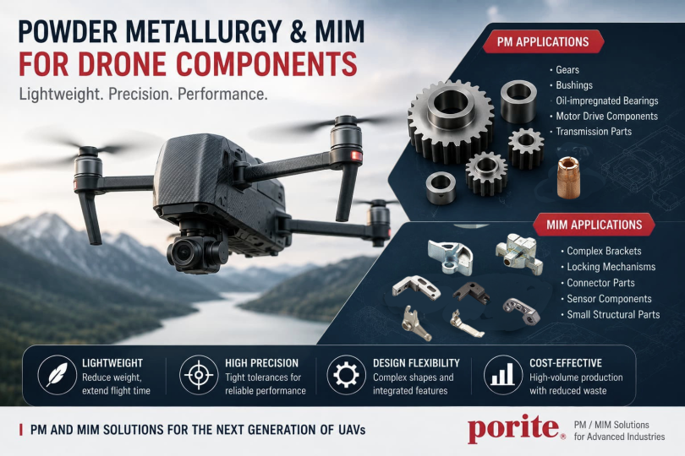
The drone industry is entering a new stage of development. Unmanned aerial vehicles (UAVs) are no longer limited to aerial photography and recreational use. They are increasingly being deployed for logistics and delivery, infrastructure inspection, smart agriculture, public safety, surveillance, and emerging advanced air mobility applications.
As these applications become more demanding, UAV manufacturers face a difficult engineering challenge: how can more functionality, durability, and mechanical performance be integrated into an aircraft without adding unnecessary weight or production cost?
Every gram matters in a drone. Additional weight can affect flight time, payload capacity, maneuverability, and energy consumption. At the same time, components used in motors, transmission mechanisms, control systems, and sensing modules must remain reliable under repeated operation.
This is where Powder Metallurgy (PM) and Metal Injection Molding (MIM) can provide valuable manufacturing alternatives for selected UAV components.
Porite Taiwan has identified drones as an important application field for its PM and MIM technologies, particularly as UAV manufacturers demand lightweight, high-performance, and highly reliable precision metal components. You can explore more industries supported by Porite on the Applications page.
What Challenges Do Drone Component Manufacturers Face?
Unlike many stationary industrial systems, drones operate under strict limitations on size, weight, and available power. Improving one aspect of the design can easily compromise another.
For UAV manufacturers, several component-level challenges are particularly important.
- Weight reduction: Lighter aircraft generally provide greater flexibility for payload capacity and energy management, but reducing weight cannot come at the expense of mechanical reliability.
- Component miniaturization: Modern drones integrate motors, sensors, cameras, communication systems, control electronics, and increasingly sophisticated autonomous functions into limited spaces.
- Production scalability: CNC machining may be practical during prototype development, but machining every small metal component individually can become costly when a successful UAV platform moves into higher-volume production.
- Reliability and repeatability: Components used in drive systems, moving mechanisms, and control assemblies must maintain consistent dimensions and performance across large production quantities.
The challenge is therefore not simply making components smaller. It is making them smaller, lighter, reliable, repeatable, and economically scalable at the same time.
Where Can Powder Metallurgy Be Used in UAV Manufacturing?
Powder Metallurgy forms metal powder under pressure before sintering it into a finished component. Because the process can manufacture near-net-shape parts with high material utilization, it is particularly valuable when the same mechanical component needs to be produced repeatedly at scale.
Porite’s Powder Metallurgy process is designed for economical mass production of precision components while reducing material waste and secondary machining. PM can also create porous structures that are difficult to achieve through conventional machining, making oil-impregnated bearings one of its distinctive applications.
For UAV systems, potential PM applications include components associated with:
- Motor drive systems
- Transmission mechanisms
- Small gears
- Bushings
- Oil-impregnated bearings
- Mechanical drive components
- Other compact sintered structural parts
One particularly interesting application is the sintered oil-impregnated bearing.
The porous structure of a sintered bearing can retain lubricating oil within the material. This provides lubrication during operation without requiring a conventional external lubrication arrangement, making the technology useful for compact rotating mechanisms where space and maintenance requirements matter.
For high-volume UAV production, PM also offers another important advantage: material efficiency.
Instead of machining away significant amounts of material from bar stock, PM forms the component close to its final geometry. This can reduce material waste and the amount of secondary machining required.
For a broader view of Porite’s PM, MIM, bearing, and post-processing capabilities, see the Manufacturing Process page.
Why MIM Is Valuable for Small and Complex Drone Components
Not every UAV component suitable for powder-based manufacturing has a geometry that can be efficiently produced using conventional PM.
Modern drones increasingly contain small metal components with complex three-dimensional shapes, thin features, holes, recesses, and integrated functions. These are areas where Metal Injection Molding (MIM) becomes particularly valuable.
MIM combines metal powders with injection-molding technology. After molding, the component undergoes debinding and sintering to produce a dense metal part.
Porite’s MIM process is specifically designed for complex metal geometries that may be difficult to mass-produce using traditional PM and expensive to manufacture through machining.
Potential UAV applications can include:
- Compact brackets
- Small mounting components
- Locking mechanisms
- Sensor-related metal components
- Connector components
- Complex actuator parts
- Small structural components with integrated features
The major advantage is design integration.
A component that might otherwise require several separately machined pieces and an assembly process may, depending on its design, be consolidated into a single MIM component. This can help reduce part count, simplify assembly, and make compact mechanical systems easier to manufacture at scale.
Learn more about material options, density, mechanical performance, and complex-shape manufacturing on Porite’s Metal Injection Molding (MIM) page.
PM or MIM: Which Is Better for Drone Components?
Neither technology is universally better. They solve different manufacturing problems.
| Requirement | Powder Metallurgy (PM) | Metal Injection Molding (MIM) |
|---|---|---|
| High-Volume Production | Excellent | Excellent for suitable parts |
| Material Utilization | High | High |
| Small Gears | Suitable | Suitable for more complex geometries |
| Bearings / Bushings | Excellent | Usually not the primary choice |
| Complex 3D Geometry | More limited than MIM | Excellent |
| Thin / Intricate Features | Limited | Excellent |
| Self-Lubricating Components | Excellent | Not the primary advantage |
| Integrated Component Design | Moderate | Excellent |
| Typical UAV Role | Drive and mechanical components | Small complex precision components |
A useful way to think about the difference is:
PM is particularly attractive when production efficiency, repeatability, mechanical function, and high-volume economics are the priority.
MIM becomes more attractive when the component is small and geometrically complex, especially when conventional machining would require multiple operations or separate assembled parts.
In practice, an advanced UAV platform may benefit from both technologies.
From Prototype to Mass Production: When Should UAV Manufacturers Consider PM or MIM?
One common mistake is evaluating manufacturing cost based only on the price of a prototype.
During UAV development, CNC machining and additive manufacturing provide significant flexibility because designs can be changed without investing in dedicated mass-production tooling.
However, the optimal process may change once the design is finalized.
For a component expected to enter high-volume production, manufacturers should evaluate:
- Annual production quantity
- Part size and weight
- Required mechanical properties
- Dimensional tolerances
- Geometry complexity
- Material requirements
- Secondary machining requirements
- Assembly operations
- Tooling investment
- Expected product lifecycle
A component that is inexpensive to CNC machine in quantities of 100 may not remain economical at 100,000 units.
Conversely, a component with unstable geometry or low expected production volume may not justify PM or MIM tooling.
Therefore, manufacturing process selection should be considered early in UAV component design, especially when a platform is expected to transition from prototype development to commercial-scale production.
If you are comparing manufacturing methods for precision mechanical parts, Porite’s article PM vs. MIM vs. CNC Machining also provides a useful overview of how production volume, part complexity, and performance requirements influence process selection.
How Porite Supports UAV Component Development
Porite Taiwan provides both Powder Metallurgy and Metal Injection Molding capabilities, allowing different manufacturing technologies to be evaluated according to component requirements rather than forcing every metal component into a single process.
Its conventional Powder Metallurgy process combines compaction and sintering with machining, sizing, and various heat-treatment capabilities. Its MIM process uses internally mixed feedstock followed by injection molding, debinding, and sintering. More information is available on Porite’s Manufacturing Process page.
For UAV manufacturers, these capabilities can support engineering decisions based on:
- Component geometry
- Size and weight targets
- Mechanical requirements
- Material selection
- Production volume
- Precision requirements
- Manufacturing cost
- Scalability
This is particularly relevant as modern drones increasingly depend on efficient motor drive systems, transmission mechanisms, flight-control modules, and sensing systems—all areas where component weight, reliability, and manufacturing consistency can influence overall UAV performance.
Explore Porite’s application solutions for more information about PM and MIM technologies across drones, robotics, automotive, thermal management, and other advanced industries.
Building Smaller, Lighter, and More Scalable UAV Systems
The next generation of UAVs will demand more than simply lighter materials. Manufacturers must achieve a practical balance between weight, mechanical performance, component complexity, reliability, and production cost.
Powder Metallurgy provides an efficient route for selected high-volume mechanical parts, gears, bearings, bushings, and drive-system components. MIM extends powder-based manufacturing into small and geometrically complex precision metal parts that may otherwise require costly machining or multi-part assembly.
The right choice ultimately depends on the component.
By considering PM and MIM during the design stage—not only after a component has already been designed for machining—UAV manufacturers can identify opportunities to reduce material waste, simplify production, consolidate components, and prepare successful drone platforms for scalable manufacturing.
Looking for PM or MIM Solutions for UAV Components?
Whether you are developing commercial drones, industrial inspection UAVs, logistics drones, agricultural drones, or other unmanned aerial systems, selecting the right manufacturing process is essential to balancing weight, reliability, precision, and production cost.
Porite can help evaluate suitable Powder Metallurgy and Metal Injection Molding solutions based on your component geometry, material requirements, production volume, and performance targets.