
News Release
Media
What Makes Humanoid Robot Joints Move Smoothly and Precisely? Key Components and Performance Factors
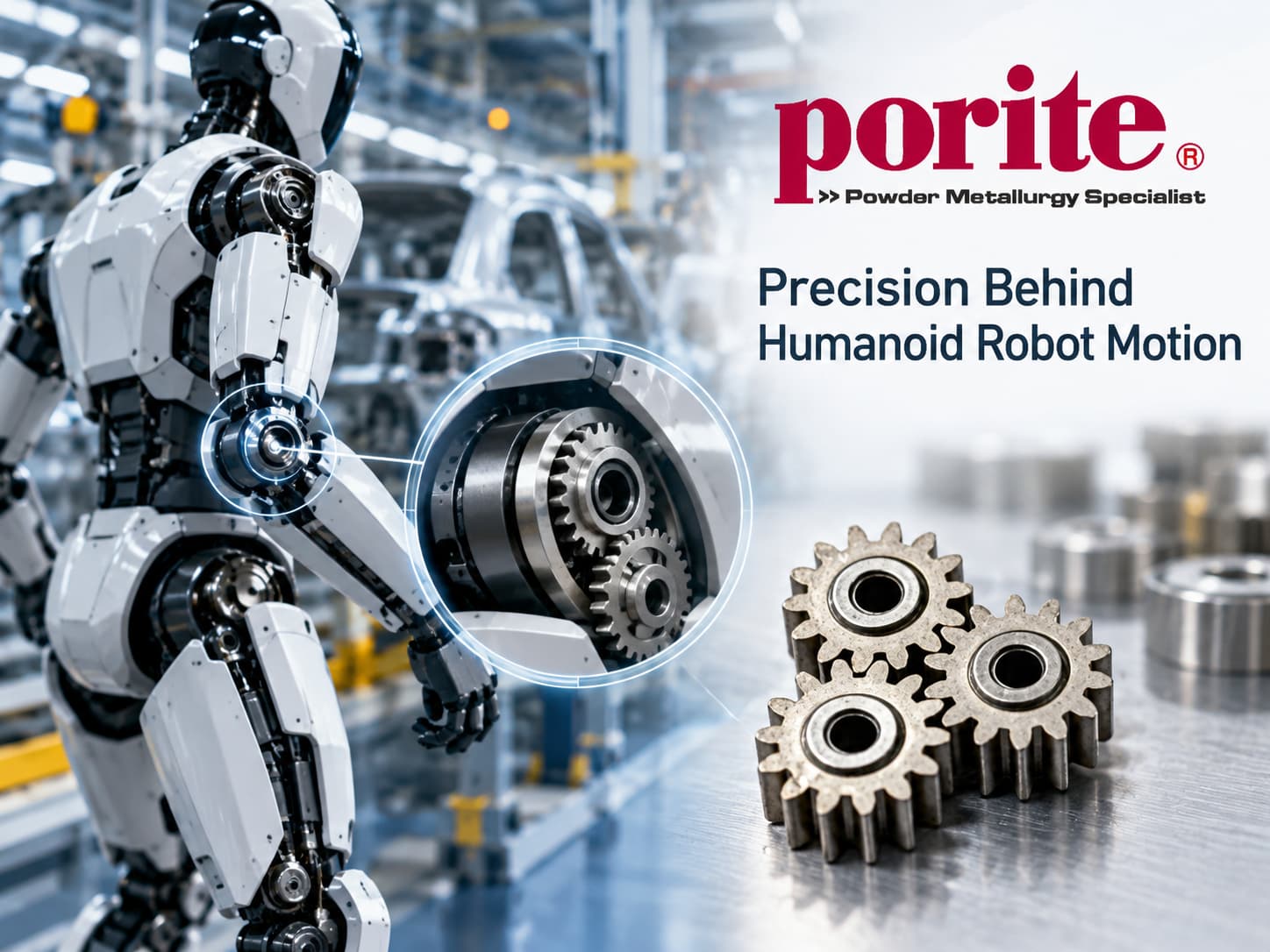
Smooth humanoid robot movement depends on more than powerful motors. Precision gears, reducers, bearings, and control systems must work together to deliver accurate, repeatable motion.
As humanoid robots enter real factories, component precision, durability, and manufacturing consistency are becoming increasingly important.
Developing precision gears or metal components for robotics? Contact Porite Taiwan to discuss your manufacturing requirements.
1. BMW and Figure AI: Humanoid Robots Enter Automotive Factory Operations
In 2025, BMW Group deployed Figure AI's Figure 02 humanoid robot at its Spartanburg automotive plant in the United States.
According to BMW Group's official announcement published on February 27, 2026, Figure 02 handled and positioned sheet-metal components for BMW X3 production, demonstrating the potential of humanoid robots in repetitive industrial operations.
BMW's 2025 Humanoid Robot Deployment
| Deployment Results | Reported Figures |
|---|---|
| Components handled | 90,000+ |
| Operating hours | Approx. 1,250 |
| Robot steps | Approx. 1.2 million |
| BMW X3 vehicles supported | 30,000+ |
Source: BMW Group PressClub, February 27, 2026. Figures describe the deployment rather than individual joint specifications.
This application highlights why robot joints must maintain consistent positioning and reliable movement during repeated operations.
For related manufacturing solutions, explore Porite Taiwan's Robotics Applications.
2. What Components Make Humanoid Robot Joints Move?
A typical electrically driven humanoid robot joint combines several key components.
| Component | Function |
|---|---|
| Motor | Generates rotational motion |
| Gear reducer | Adjusts speed and increases torque |
| Precision gears | Transfer torque and motion |
| Bearings | Support loads and maintain alignment |
| Sensors and encoders | Provide positioning feedback |
The performance of these components determines how accurately and consistently a joint responds to movement commands.
Learn more about Precision Gearbox and Transmission Component Applications.
3. What Affects Humanoid Robot Joint Precision?
Five mechanical factors are particularly important.
| Factor | Effect on Robot Movement |
|---|---|
| Backlash | Excessive clearance causes lost motion during direction changes |
| Transmission stiffness | Limits deformation under load |
| Gear accuracy | Influences vibration and positioning consistency |
| Bearing support | Maintains alignment and supports loads |
| Friction and wear | Affect efficiency and component life |
For example, a joint with excessive backlash may respond less accurately when reversing direction, while insufficient stiffness can cause positioning errors under heavy loads.
Key Takeaway: Robot joint precision should be evaluated under actual loads and repeated operating cycles, not only through dimensional inspection.
4. Do Different Robot Joints Need Different Components?
Different joints require different combinations of torque, accuracy, and compactness.
| Joint | Main Requirements |
|---|---|
| Hip and knee | High torque, load capacity, stiffness |
| Ankle | Responsive motion, stability |
| Shoulder and elbow | Accurate positioning, efficiency |
| Wrist | Compact design, precise movement |
| Fingers | Miniature components, repeatability |
A knee joint may prioritize load capacity, while a finger mechanism requires smaller components for precise, repeated movements.
5. How Can Porite Taiwan Support Robot Joint Component Manufacturing?
Robot joint components require consistent dimensions, suitable material properties, and reliable production processes.
Porite Taiwan offers three relevant manufacturing technologies:
Powder Metallurgy (PM)
Suitable for repeatable production of certain gears, bushings, and transmission components with efficient material utilization.
High Density & High Performance Powder Metallurgy (HPM)
Supports suitable small precision gears requiring higher density and improved mechanical properties.
Explore Porite Taiwan's HPM Technology.
Metal Injection Molding (MIM)
Suitable for certain small, complex metal components with intricate geometries.
Explore Porite Taiwan's Manufacturing Processes.
The appropriate manufacturing process depends on component geometry, mechanical loads, tolerances, and production volume.
For a more detailed comparison, read PM vs. HPM vs. MIM vs. CNC Machining: Which Manufacturing Process Is Best for Robot Components?
6. What Information Should Engineers Provide?
To evaluate manufacturing feasibility, engineers should prepare:
- Technical drawings: Dimensions, geometry, and tolerances.
- Performance requirements: Torque, loads, accuracy, and expected service life.
- Material specifications: Strength, hardness, and wear resistance.
- Production requirements: Prototype quantities and estimated annual volume.
Providing these details helps manufacturers assess suitable processes and production requirements.
Contact Porite Taiwan to discuss your project specifications.
7. Frequently Asked Questions
What causes inaccurate humanoid robot joint movement?
Excessive backlash, insufficient stiffness, gear errors, friction, and alignment problems can all affect joint precision.
Can powder metallurgy manufacture humanoid robot gears?
Yes. PM and HPM can be suitable for certain precision gears, depending on strength, geometry, tolerances, and operating conditions.
Which manufacturing process is best for miniature robot components?
HPM may suit certain high-density small gears, while MIM can be considered for complex miniature metal parts. Selection depends on component requirements.
Conclusion: Reliable Robot Motion Starts with Precision Components
BMW's humanoid robot deployment shows the growing importance of reliable joint movement in industrial applications.
For robot developers, selecting suitable gears, materials, and manufacturing processes is essential to achieving consistent performance.
Porite Taiwan supports precision metal component manufacturing through PM, HPM, and MIM technologies.
Looking for a manufacturing partner? Contact Porite Taiwan to discuss your robot component drawings and production requirements.