
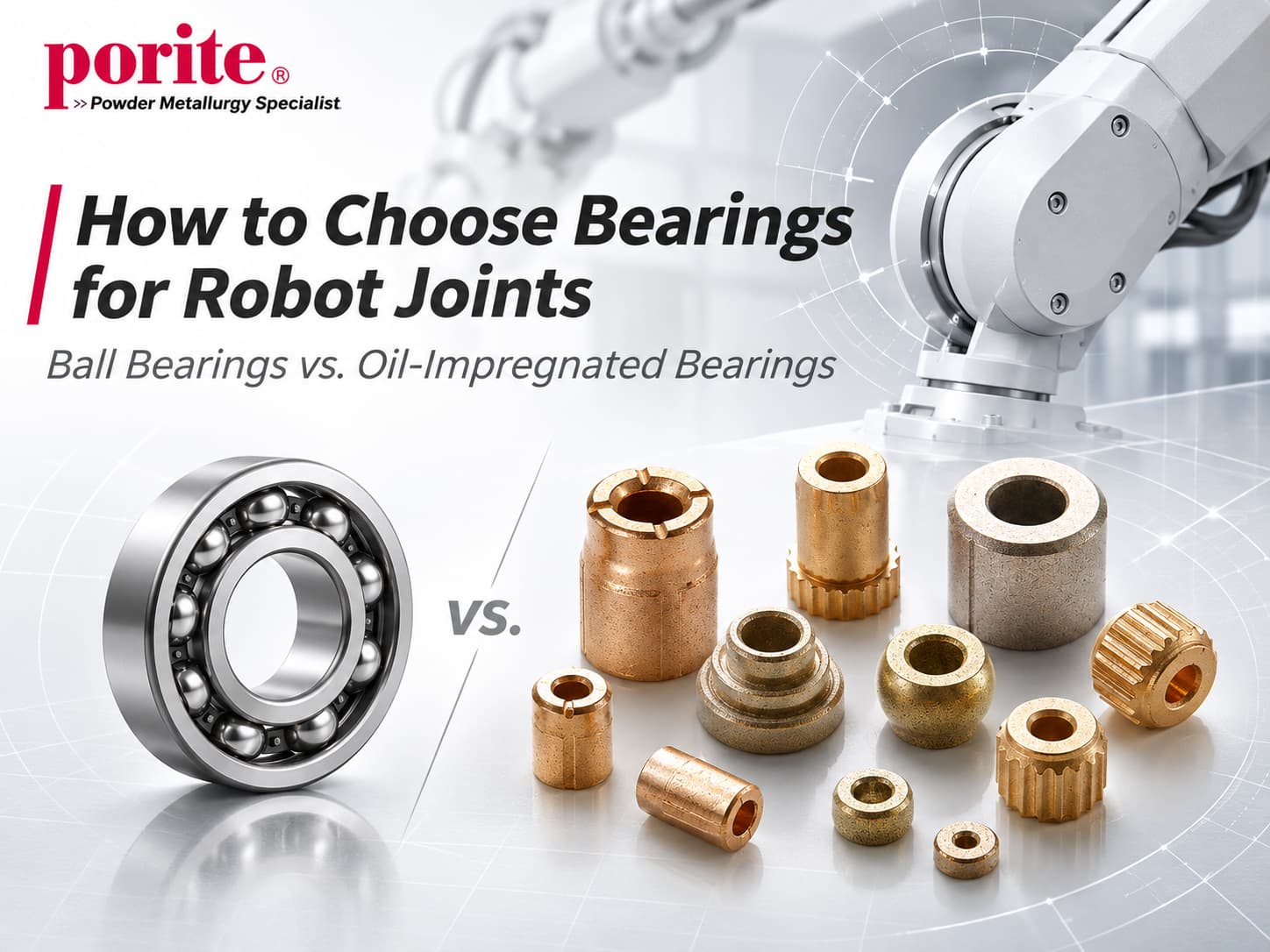
Choosing the right bearings for robot joints requires balancing load capacity, positioning accuracy, friction, noise, service life, and cost.
Ball bearings are generally preferred for precision joint support involving significant loads, while oil-impregnated bearings may be suitable for compact, lower-load rotating mechanisms where simplified lubrication and cost efficiency are priorities.
However, neither bearing type is suitable for every application. Engineers must evaluate the bearing's actual function, movement pattern, and operating conditions before making a decision.
For an overview of how bearings, gears, and reducers contribute to robot motion, see our previous article: What Makes Humanoid Robot Joints Move Smoothly and Precisely?
1. Ball Bearings vs. Oil-Impregnated Bearings: Key Differences
Ball bearings use rolling elements to support rotational movement, while oil-impregnated bearings operate through sliding contact, supported by lubricant stored within their porous metal structure.
Their differences influence where each bearing type can be used.
| Comparison | Ball Bearings | Oil-Impregnated Bearings |
|---|---|---|
| Contact Type | Rolling contact | Lubricated sliding contact |
| Load Capacity | Various designs support radial and axial loads | Limited by bearing pressure, speed, and material |
| Precision | Precision grades and preload options available | Depends on shaft clearance and alignment |
| Friction | Generally low under suitable conditions | Varies with lubrication and sliding conditions |
| Noise | Influenced by bearing quality and installation | Can operate quietly under suitable conditions |
| Maintenance | Sealed and pre-lubricated options available | Stored oil reduces external lubrication needs |
| Cost | Varies by precision grade and configuration | Potential advantages in suitable mass production |
| Typical Applications | Precision joint support and rotating assemblies | Compact auxiliary rotating mechanisms |
The main distinction is their mechanical behavior. Ball bearings are commonly selected when load support and rotational accuracy are priorities, while oil-impregnated bearings can be considered when sliding contact is acceptable within the available space and operating conditions.
2. How Do Bearing Types Affect Durability and Service Life?
Bearing service life depends on the operating load, movement frequency, speed, temperature, and lubrication conditions.
Ball Bearings: Load Rating and Fatigue Life
Ball bearings must be selected according to their dynamic and static load ratings, bearing arrangement, and expected operating cycles.
In applications involving significant loads, selecting the appropriate bearing type helps maintain reliable support and positioning performance.
However, repeated small-angle oscillation can create additional wear risks, including false brinelling, particularly under unfavorable lubrication conditions.
Oil-Impregnated Bearings: PV Limits and Wear
For oil-impregnated bearings, an important selection parameter is the PV value, calculated from bearing pressure (P) multiplied by sliding velocity (V).
Operating beyond the recommended PV limit may cause excessive heat and accelerated wear.
Engineers should also evaluate lubricant retention and the movement pattern. Frequent reversals or very short oscillating movements may prevent the formation of an adequate lubricating film.
Engineering Tip: Service-life estimates should be based on the intended duty cycle. A bearing suitable for continuous rotation may not perform equally well under repeated short-angle movement.
3. How Do Ball Bearings and Oil-Impregnated Bearings Compare in Noise and Friction?
Noise and friction affect motion quality, especially in service robots, collaborative robots, and compact automation equipment.
However, neither bearing type is inherently quieter under every operating condition.
Ball Bearings
Rolling contact generally provides low friction. Noise and vibration can increase due to improper preload, contamination, misalignment, or inadequate lubrication.
Precision bearing designs can help control rotational performance when properly installed.
Oil-Impregnated Bearings
Oil-impregnated bearings can provide quiet rotation when sufficient lubrication separates the shaft and bearing surface.
Their performance depends on shaft finish, bearing clearance, lubricant properties, and operating speed.
At low speeds or during startup, boundary lubrication may occur, increasing friction compared with fully lubricated operation.
Engineering Tip: For equipment with strict noise requirements, test bearing performance under the actual load and speed rather than relying on theoretical comparisons alone.
4. Cost and Maintenance: What Should Engineers Consider?
For OEM manufacturers, bearing cost includes more than the initial purchase price.
Engineers should consider assembly complexity, lubrication arrangements, replacement requirements, and production volume.
Ball Bearings
Precision grades, sealing options, and mounting requirements can increase component and assembly costs. However, sealed or pre-lubricated bearings may reduce routine maintenance.
Oil-Impregnated Bearings
Powder metallurgy manufacturing can provide cost advantages in suitable high-volume production. The bearing's stored lubricant may also simplify the surrounding mechanism by reducing the need for external lubrication components.
These advantages depend on the application. Premature wear or unsuitable operating conditions can outweigh any initial cost savings.
For a detailed explanation of their self-lubricating properties, see Powder Metallurgy Oil-Impregnated Bearings: A Key Solution for Maintenance-Free Drive Systems.
Cost Consideration: Compare the total cost of the bearing assembly over its expected service life, not just the unit price.
5. Which Bearing Is Right for Your Robot Joint Application?
The best starting point is to identify the mechanism's actual requirements.
The following guide helps engineers and purchasing teams determine which bearing type should be evaluated first.
Bearing Selection Guide: Which Bearing Should You Consider?
| Application Requirements | Recommended Bearing | Key Consideration |
|---|---|---|
| High loads & precision | Ball Bearings | Load rating & accuracy |
| Compact, low-load rotation | Oil-Impregnated | PV limit & clearance |
| Minimal lubrication | Oil-Impregnated | Operating conditions |
| High positioning accuracy | Ball Bearings | Stiffness & preload |
| Frequent start-stop motion | Both – Evaluate | Lubrication & wear |
| High-volume, cost-sensitive production | Both – Compare | Total production cost |
*Recommendations indicate which option to evaluate first. Final selection requires verification against actual operating conditions.
Practical Application Examples
Scenario A: Main Robot Joint Support
A robot arm joint must maintain accurate positioning while supporting radial and axial loads.
Precision rolling-element bearings are generally the preferred starting point. Depending on the required stiffness and load configuration, engineers may also consider crossed-roller bearings or other specialized arrangements.
Scenario B: Compact Auxiliary Rotating Mechanism
A small auxiliary component operates with relatively low radial loads, limited installation space, and repeated rotational movement.
An oil-impregnated bearing may be considered if the operating pressure, speed, shaft clearance, and service-life requirements fall within the selected bearing's specifications.
What Should Engineers Prepare Before Bearing Selection?
For a more efficient technical evaluation, OEM customers should provide:
- Load: Radial and axial loads, including peak conditions.
- Motion: Speed, rotation angle, and operating frequency.
- Dimensions: Shaft diameter, available space, and required tolerances.
- Environment: Temperature, contamination, and lubrication restrictions.
- Project Requirements: Expected service life and annual production volume.
These specifications help determine whether a standard bearing design is suitable or whether further development and testing are necessary.
6. When Should You Consider PORITE's Oil-Impregnated Bearings?
For manufacturers developing compact rotating components, PORITE TAIWAN CO., LTD. offers powder metallurgy manufacturing capabilities for oil-impregnated micro bearings.
PORITE's manufacturing process includes powder compaction, sintering, sizing, and oil impregnation or vacuum oil impregnation.
According to its published manufacturing information, PORITE has supplied micro bearings for electric motors, automotive systems, cooling fans, household appliances, and other electronic products.
PORITE's Manufacturing Capabilities
- Powder Metallurgy Production: PORITE uses powder metallurgy processes to manufacture sintered metal components with repeatable dimensions and efficient material utilization.
- Oil Impregnation Technology: Its micro bearing manufacturing process incorporates oil impregnation to provide lubricant within the porous bearing structure.
- High-Volume Production: PORITE operates a dedicated micro bearing manufacturing facility, supporting the production requirements of OEM customers.
Learn more about PORITE's Manufacturing of Micro Bearings.
Evaluating Oil-Impregnated Bearings for Robotics Applications
For robot-related components, oil-impregnated bearings may be worth considering in suitable auxiliary rotating mechanisms where load, speed, and accuracy requirements permit sliding bearings.
Their suitability should be confirmed through technical evaluation rather than assumed from applications in other industries.
OEM manufacturers can share component drawings, operating conditions, and production requirements with PORITE to discuss manufacturing feasibility.
7. FAQ: Choosing Bearings for Robot Joints
Q1. Can oil-impregnated bearings operate without regular relubrication?
They can reduce or eliminate scheduled external relubrication in suitable applications during their designed service life.
However, lubricant availability is finite, and operating temperature, speed, and load affect how long the bearing can perform reliably.
Q2. Can oil-impregnated bearings be customized for OEM projects?
Powder metallurgy manufacturing can accommodate different component geometries and dimensions, subject to tooling, material properties, and process limitations.
Customization feasibility, tolerances, and production quantities should be confirmed with the manufacturer.
Q3. How should engineers verify bearing performance before mass production?
Engineers should test samples under representative loads, speeds, temperatures, and movement cycles.
Key measurements may include friction, wear, temperature rise, noise, and dimensional changes. Results should be compared against the equipment's design requirements before production approval.
Conclusion: Select Bearings Based on Application Requirements
Ball bearings and oil-impregnated bearings serve different mechanical requirements. The right choice depends on the component's load, precision, operating cycle, and overall production needs.
For main robot joint support, precision rolling-element bearings are generally the more appropriate starting point. For suitable compact auxiliary mechanisms, oil-impregnated bearings may offer advantages in lubrication management and manufacturing efficiency.
Discuss Your Bearing Requirements with PORITE
PORITE TAIWAN CO., LTD. provides powder metallurgy and micro bearing manufacturing capabilities for OEM applications.
If you are evaluating oil-impregnated bearings for a new product, share your technical drawings and operating requirements with our team to discuss suitable manufacturing options.
Contact PORITE