
News Release
Media
Breaking the Micro-Gear Mass-Production Barrier: How Powder Metallurgy Delivers Precision, Efficiency, and Cost Advantage
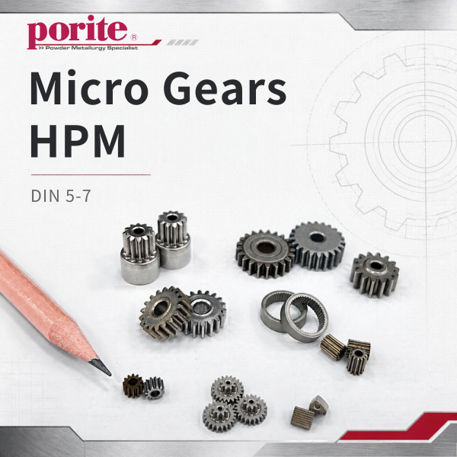
Miniaturization and precision transmission have become key design trends in medical devices, smart wearables, miniature robots, and micro-actuators. Demand for micro-gears (m < 0.3) continues to grow. However, the industry has long faced two structural challenges: the high cost of precision machining and the difficulty of achieving cost-effective mass production.
Small-module components are traditionally produced mainly by hobbing or precision form grinding. For such small gears, these cutting processes cause rapid tool wear, require frequent tool replacement, and involve long cycle times per part. As a result, unit cost rises sharply as the module decreases.
To provide an integrated mass-production solution for micro-gears, Porite Taiwan R&D team has established a manufacturing model based on powder metallurgy forming. This approach delivers a more cost-effective solution for miniature transmission components while maintaining dimensional accuracy and mechanical performance.
1. Core Challenges: Limitations of Conventional Cutting Processes
Micro-gears have extremely small geometries, including very fine transition radii at the tooth tip, root, and flank. Hobbing or grinding therefore presents the following challenges:
- Limited tool life and high cost: Small-module hobs have relatively weak cutting edges, making them susceptible to dulling and burr formation. Fine burrs are difficult to remove in subsequent deburring processes and may damage the reference tooth profile.
- Limited mass-production capacity: Cutting requires tooth-by-tooth and part-by-part machining. For consumer or medical products requiring hundreds of thousands to millions of units per month, this creates a substantial machine-capacity burden.
- Low material utilization: Turning miniature features from bar stock results in a relatively high level of raw-material loss.
2. PM Forming: A High-Efficiency Solution for Micro-Gears
Powder metallurgy is a near-net-shape manufacturing technology that relies on high-precision tooling and compensation design. Through continuous process optimization, we have overcome the forming limitations of miniature transmission components and achieved the following mass-production advantages:
- Outstanding cost-effectiveness and delivery efficiency
Complex tooth profiles and bore structures can be formed in a single pressing stroke. While cutting or grinding may require several minutes, each pressing cycle takes only a few seconds. Output can therefore increase by several dozen times, while equipment depreciation, labor hours, and tooling-consumable costs are significantly reduced.
- Tooling compensation design and high-precision gear manufacturing
Shrinkage and deformation after sintering are major factors affecting the accuracy of powder-metallurgy parts. Through precise tooth-profile compensation in the tooling, together with Porite’s extensive process experience and technical advances, our PM gears can achieve DIN 5–7 accuracy, comparable to conventional precision hobbing.
3. Process Comparison
|
Evaluation Criterion |
Conventional Hobbing / Grinding |
Precision PM Forming |
|
Production cycle |
Several minutes per part; costly to scale up |
Only a few seconds per forming cycle; suitable for million-unit production |
|
Material utilization |
Turning removes a large portion of the material (40%–60%) |
Near-net-shape manufacturing with material utilization above 95% |
|
Unit manufacturing cost |
Rises sharply as the module decreases |
Clear cost advantage in mass production and strong market competitiveness |
Outlook
As transmission systems evolve toward lighter weight, smaller size, and higher torque density, precision micro-gears with modules below 0.3 are no longer limited to costly cutting processes. With mature PM material formulations, high-precision tooling, and rigorous sizing-tolerance control, PM provides an ideal solution that combines excellent performance with mass-production efficiency.