
News Release
Media
From Component to Commitment: How SOFC Technology Powers Your ESG Strategy
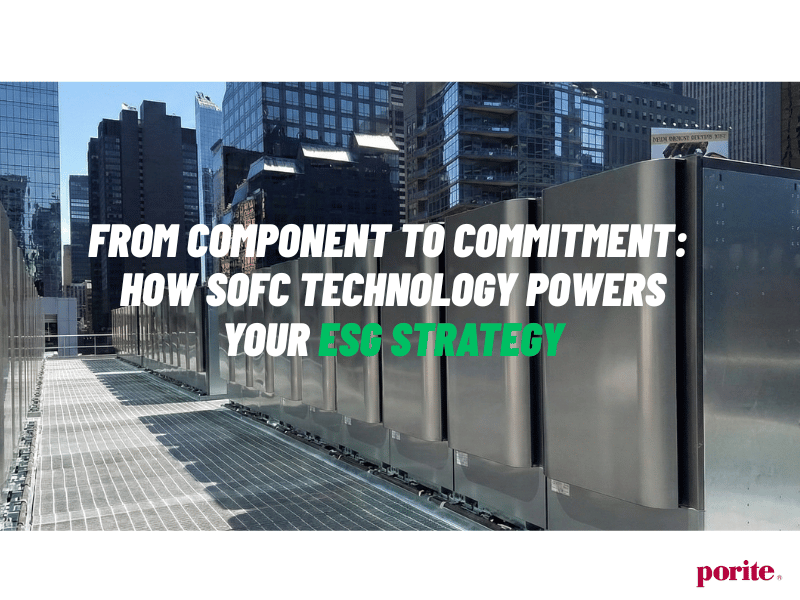
In our previous discussion, Rethinking Clean Power, we explored the rigorous engineering demands of Solid Oxide Fuel Cells (SOFC) and the critical role of high-quality interconnect plates. This month, we look beyond the hardware to answer a bigger question: Why does this technology matter for the future of your business?
As the global push for Net Zero intensifies, forward-thinking companies are no longer viewing energy systems merely as operational costs. Instead, energy choices have become a cornerstone of corporate ESG (Environmental, Social, and Governance) strategies.
Here is how adopting SOFC technology—supported by precision manufacturing—transforms from a simple power solution into a powerful commitment to sustainability.
1. Environmental (E): Efficiency is the First Step to Decarbonization
The most immediate impact of SOFC adoption is on the "E" in ESG. Unlike traditional combustion engines that burn fuel to create energy, fuel cells generate electricity through an electrochemical reaction. This fundamental difference offers two distinct advantages:
- Drastically Reduced Emissions: SOFCs operate with high electrical efficiency (often exceeding 60%), meaning less fuel is required to generate the same amount of power. This directly lowers Scope 1 and Scope 2 carbon emissions. Furthermore, the process produces virtually no nitrogen oxides (NOx) or sulfur oxides (SOx), contributing to cleaner local air quality.
- The Bridge to Hydrogen: One of the greatest challenges in the green transition is the gap between current infrastructure and future goals. SOFCs are unique because they are fuel-flexible. They can run efficiently on natural gas or biogas today and are "Hydrogen-Ready" for tomorrow. Investing in SOFCs allows businesses to decarbonize immediately while future-proofing their assets for a hydrogen economy.
2. Governance (G): Energy Security as Risk Management
In the realm of Governance, risk management is key. As extreme weather events and grid instability become more frequent, relying solely on centralized power grids poses a significant operational risk.
SOFCs provide a robust distributed power solution. By generating power on-site, businesses gain energy independence and resilience. This ensures business continuity during outages—a critical metric for stakeholders and investors who value stable, well-governed operations.
3. Social & Supply Chain (S): The Value of Green Manufacturing
Sustainability is not just about what you use; it is about how it was made. Scope 3 emissions (supply chain emissions) often make up the largest part of a company’s carbon footprint. This is where Porite’s expertise becomes a strategic asset for our partners.
Our core technology, Powder Metallurgy (PM), is inherently a green manufacturing process.
- Material Efficiency: Unlike traditional machining, which subtracts material and creates waste, powder metallurgy is a "near-net shape" process. We use exactly what is needed, minimizing raw material waste.
- Responsible Sourcing: By choosing Porite’s interconnect plates, our clients are integrating components into their systems that are manufactured with minimal waste and high precision.
Bridging the Gap: Durability is Sustainability
Finally, a truly sustainable solution must be built to last. A fuel cell stack that degrades quickly becomes electronic waste.
This is why Porite focuses relentlessly on the quality of our Interconnect Plates. By utilizing advanced materials and coating technologies to prevent oxidation and maintain conductivity, we extend the lifespan of the fuel cell stack. We help turn a power system into a long-term infrastructure asset.
Conclusion
The transition to clean energy requires more than just ambition; it requires reliable, high-performance technology.
At Porite Taiwan, we do not just manufacture components; we engineer the foundation for your green energy transition. By combining our expertise in powder metallurgy with the advanced requirements of the energy sector, we are helping the world build a cleaner, more resilient future—layer by layer.