
News Release
Media
Powder Metallurgy Manufacturing for High-Growth Industries: Robotics, Electric Vehicles, and Data Centers
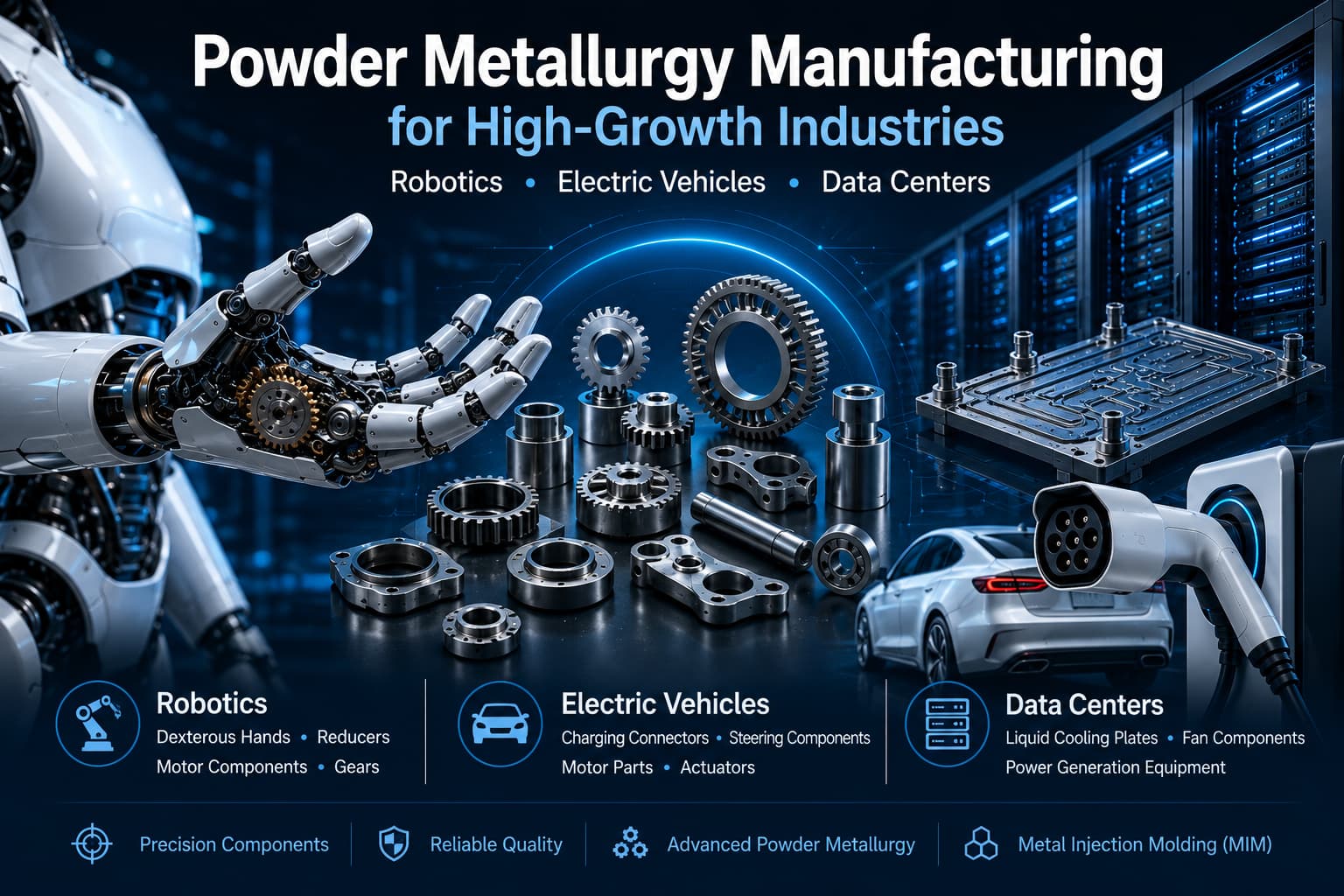
AI, Robotics, and EVs Are Creating a New Wave of Demand for Precision Metal Components
Over the past few years, industries such as artificial intelligence, robotics, electric vehicles (EVs), and data centers have experienced extraordinary growth. Humanoid robots are moving from research labs into commercial applications, EV adoption continues to increase worldwide, and AI-driven data centers are expanding at an unprecedented pace.
While much of the attention is focused on software, processors, batteries, and advanced electronics, these technologies all depend on something far more fundamental: precision mechanical components.
From miniature gears inside robotic hands to motor components in robotic vacuums, from EV steering systems to server cooling equipment, reliable metal parts remain essential to performance, durability, and efficiency. As these industries scale, manufacturers are increasingly turning to advanced manufacturing technologies such as powder metallurgy and metal injection molding (MIM) to produce complex, high-precision components at volume.
Why Emerging Industries Need Advanced Metal Manufacturing Technologies
Although robotics, EVs, and AI infrastructure serve different markets, they share many of the same engineering challenges.
Modern products are expected to be:
- Smaller and more compact
- More energy efficient
- More durable
- More precise
- Suitable for mass production
Traditional machining remains important, but it is not always the most efficient solution for producing high volumes of intricate metal parts.
This is where technologies based on advanced metal powder production offer significant advantages. Powder metallurgy and MIM enable manufacturers to create complex geometries, maintain tight tolerances, reduce material waste, and support large-scale production without sacrificing quality.
As a result, these technologies are becoming increasingly important in the world's fastest-growing industries.
Humanoid Robots: Precision Components for Dexterous Hands and Motion Systems
Among all emerging technologies, humanoid robots have attracted enormous attention. One of the most technically challenging areas of a humanoid robot is its dexterous hand.
Unlike traditional industrial robots, humanoid robots must perform delicate movements that mimic human hand functions. This requires a large number of miniature mechanical components working together within a very limited space.
Examples include:
- Finger joint components
- Miniature gears
- Motion transmission parts
- Structural support components
Many of these parts require complex geometries, high dimensional accuracy, and excellent wear resistance. Metal injection molding is often an ideal manufacturing solution because it can produce intricate shapes while maintaining the strength and durability of metal.
At the same time, humanoid robots rely heavily on reducers and transmission systems throughout their joints and actuators. Powder metallurgy can support the production of gears and transmission-related components that require both precision and cost-effective scalability.
From Robotic Vacuums to Industrial Robots: Motor Components Remain Critical
Robotics extends far beyond humanoid systems. Service robots, robotic vacuum cleaners, warehouse robots, AGVs, AMRs, and collaborative robots are becoming increasingly common in homes, factories, and logistics centers.
Regardless of the application, most robotic systems depend on electric motors for movement and positioning.
These motors require components such as:
- Motor gears
- Self-lubricating bearings
- Transmission components
- Rotor-related parts
For products like robotic vacuums, manufacturers must balance performance, durability, and production cost. Powder metallurgy is particularly well suited for these applications because it enables efficient high-volume production while maintaining consistent quality.
As automation continues to expand across industries, demand for motor-related powder metallurgy components is expected to grow significantly.
Electric Vehicles Continue to Drive Demand for Precision Metal Parts
The automotive industry is undergoing one of the largest transformations in its history. As electric vehicles become more mainstream, manufacturers are rethinking vehicle architectures and component designs.
Many EV systems require compact, reliable metal parts capable of operating under demanding conditions.
EV Charging Connector Components
Charging connectors are exposed to frequent use, environmental factors, and electrical loads. Precision metal components help ensure reliable electrical contact and long service life.
Steering System Components
Modern steering systems require high levels of reliability and durability. Components must maintain precise performance while withstanding continuous vibration and mechanical stress.
Electric Motor and Actuator Components
EVs contain numerous electric motors and actuators used throughout the vehicle. These systems often rely on gears, bearings, and structural components manufactured through powder metallurgy and MIM technologies.
As EV production volumes increase globally, manufacturers are looking for efficient ways to produce high-performance components at scale.
AI Data Centers Are Transforming Cooling and Power Infrastructure
The rapid adoption of artificial intelligence is fueling a massive expansion of data center infrastructure worldwide.
As computing power increases, heat generation becomes one of the industry's greatest challenges. This is driving investment in advanced thermal management technologies and supporting equipment.
Liquid Cooling Components
Liquid cooling systems are becoming increasingly common in AI servers because they offer more efficient heat removal than traditional air-cooling methods.
These systems require precision metal components that support:
- Reliable fluid flow
- Thermal conductivity
- Long-term durability
Server Cooling Fan Components
Even with liquid cooling technologies, cooling fans remain critical in many server environments. Fan assemblies require durable motor and bearing components capable of operating continuously for extended periods.
Data Center Power Generation Equipment
Backup power systems and supporting energy infrastructure are essential for maintaining uptime in mission-critical facilities.
These systems often incorporate precision gears, bearings, and structural components that must operate reliably under demanding conditions.
As data center investments continue to accelerate, opportunities for powder metallurgy and MIM components are expected to expand alongside them.
Why Metal Powder Production Matters More Than Ever
Behind every powder metallurgy or MIM component is a critical starting point: metal powder.
The quality of metal powder directly influences:
- Density
- Strength
- Dimensional accuracy
- Surface quality
- Long-term durability
For industries such as robotics, EVs, and data centers, component performance requirements continue to increase. As a result, reliable metal powder production has become a key part of advanced manufacturing supply chains.
This is why experienced metal powder manufacturers play an important role in supporting next-generation products. Consistent powder quality enables manufacturers to achieve stable production processes and predictable component performance.
How Porite Taiwan Supports Emerging Industries
At Porite Taiwan, we combine decades of experience in:
- Powder Metallurgy
- Metal Injection Molding (MIM)
- Micro Bearing Manufacturing
- Gearbox Assembly
- Precision Metal Component Engineering
Our technologies support customers across a wide range of high-growth industries, including robotics, electric vehicles, automation equipment, AI servers, and data center infrastructure.
Whether the application requires miniature gears for robotic systems, motor components for smart devices, precision parts for EVs, or components for thermal management and power systems, our manufacturing capabilities help customers bring innovative products to market efficiently and reliably.
Conclusion
The future of manufacturing is increasingly connected to robotics, artificial intelligence, electric mobility, and digital infrastructure. While these industries may appear very different, they all depend on precision metal components that deliver reliability, efficiency, and scalability.
Technologies such as powder metallurgy and metal injection molding are helping manufacturers meet these challenges, while advances in metal powder production continue to improve component performance and manufacturing efficiency.
As one of the experienced metal powder manufacturers and precision component suppliers in the industry, Porite Taiwan is committed to supporting the next generation of robotics, EVs, and data center technologies through innovative manufacturing solutions and advanced engineering expertise.