
News Release
Media
What Is High Density and High Performance Powder Metallurgy?
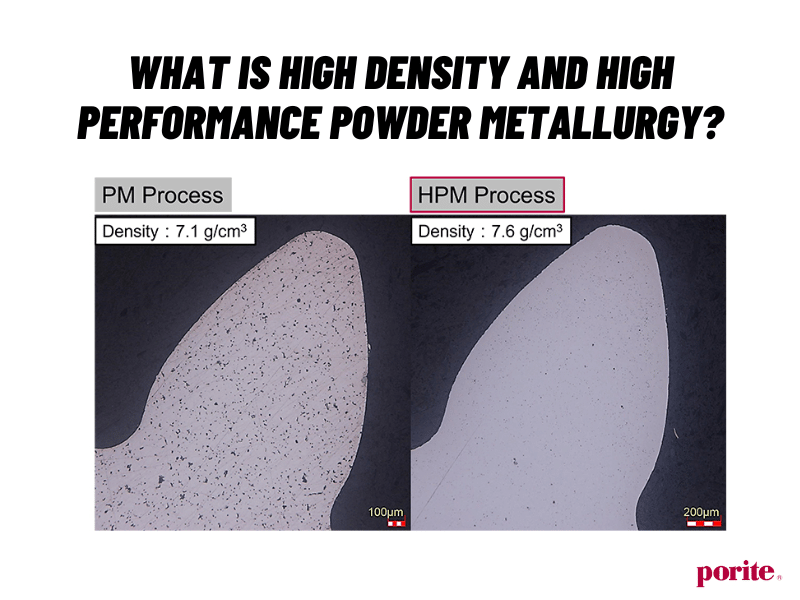
In the field of Powder Metallurgy (PM), High Density, High Performance Powder Metallurgy (HPM) is an advanced process that enhances part density and mechanical performance. Through optimized powder formulations, pressing and sintering conditions, and post-processing methods, HPM components outperform conventional PM parts in terms of strength, wear resistance, dimensional stability, and service life.
Below, we introduce the principles and characteristics of the HPM process, followed by real-world application cases from Porite, including hand tools, power tools, kitchenware, fans, and automotive refrigerant controllers.
1. What Is the HPM Process?
High Density, High Performance Powder Metallurgy refers to a variation of the PM process designed to increase the relative density of the final part (i.e., the ratio of actual density to theoretical density) and improve mechanical performance.
Core technical elements include:
-
High-quality metal powders
Finer and more uniform particle size distribution; near-spherical particles; stricter control of alloying elements to minimize impurities. -
High-pressure compaction
Higher compaction pressure and more precise die designs improve green part density and reduce porosity before sintering. -
Optimized sintering conditions
Including sintering temperature, holding time, atmosphere control (vacuum/hydrogen/inert gases), heating and cooling rates to maximize particle bonding and diffusion. -
Post-treatment and surface hardening
Such as heat treatment, surface quenching, carburizing, or nitriding to enhance surface hardness, wear resistance, and fatigue life. -
Quality control and inspection
Rigorous monitoring of density, hardness, dimensional tolerance, surface roughness, and other specifications to ensure HPM parts meet high-performance standards.
Advantages of HPM:
-
Increased strength, stiffness, and fatigue life
-
Improved wear and corrosion resistance
-
Lower porosity resulting in greater stability and reliability
-
Capable of maintaining performance under demanding environments (high temperature, high pressure, frequent load variations)
2. Why the Market and Applications Need HPM
Products such as power tools, heavy-duty hand tools, automotive components, fans, and refrigerant controllers are often required to meet the following challenges:
-
Long-term operation and repeated load cycles leading to wear and fatigue
-
High-temperature environments or large thermal cycles
-
Requirements for high dimensional accuracy, low vibration, and low noise
-
High durability under cost-sensitive constraints
The HPM process is well-suited to meet these needs, offering a step above standard powder metallurgy in performance, and providing a cost-effective alternative to machined steel or cast parts in many cases.
3. Porite’s HPM Process and Application Examples
At Porite, we have applied the HPM process to various real-world products. The following table outlines specific cases:
| Application Area | Product Type | Improvements and Benefits of HPM |
|---|---|---|
| Hand Tools | Screwdriver bits, ratchet gear components | Increased hardness and wear resistance for longer service life under heavy use; reduced deformation. |
| Power Tools | Drill gear sets, torque transmission parts | Higher density reduces vibration and noise; better pressure tolerance improves efficiency and user experience. |
| Kitchenware | Blades, hinges, and other metal parts | Enhanced surface finish and corrosion resistance; improved oxidation and anti-rust performance; balanced aesthetics and durability. |
| Fans | Bearings, rotor components | Reduced friction and wear due to high density; stable dimensions during high-temperature operation; lower noise during extended use. |
| Automotive Refrigerant Controllers | Valve bodies, control gear components | Excellent pressure and corrosion resistance; reliable long-term performance in refrigerant and control system environments; cost reduction and improved product consistency. |
In the above applications, Porite has successfully used HPM processing to deliver components that maintain excellent performance and durability under high-pressure, high-frequency, and extreme conditions.
4. Comparison: HPM vs. Conventional PM
The following table compares HPM with traditional powder metallurgy:
| Metric | Conventional PM Process | HPM Process |
|---|---|---|
| Density (relative) | Relatively high, but typically more porous | Higher density, lower porosity |
| Hardness and wear resistance | Moderate to good | Excellent, comparable to carburized or heat-treated steel |
| Dimensional stability | Good, but with greater variability | Better accuracy and tighter tolerance |
| Cost | High cost due to forming + grinding + machining | Higher initial tooling/equipment costs, but lower unit cost with volume |
| Durability | Suitable for medium-load or non-critical environments | Suitable for high-load, high-frequency, high-temperature, or corrosive conditions |
5. How to Implement HPM: Design and Manufacturing Guidelines
If you are considering using the HPM process to manufacture your products, here are some design and manufacturing guidelines to follow:
-
Evaluate density and load requirements from the design stage
Define the load, temperature, and corrosion exposure of each component, and consider how porosity affects strength and stiffness in design. -
Select suitable powder materials and particle size distribution
Powder purity and shape directly influence sintered density and mechanical properties. -
Choose proper molds and pressing equipment
High-pressure compaction machines and precise mold designs ensure uniform pressure and reduce deformation or inconsistency during forming. -
Optimize sintering conditions
Carefully control temperature, atmosphere (hydrogen, vacuum, or inert gas), holding time, and heating/cooling rates. -
Plan for post-treatment and surface hardening
For components that require surface hardness or wear resistance, surface heat treatments or coatings may be applied. -
Ensure quality inspection and consistency control
Density testing, hardness testing, dimensional inspection, vibration and noise testing are all essential.
6. Conclusion
High Density High Performance Powder Metallurgy represents a key path forward in the PM industry to enhance component performance and durability. For applications demanding high quality, high reliability, and extreme environmental resistance, the HPM process provides a critical advantage.
Porite’s technological expertise and proven case studies show that we can help customers achieve the perfect balance of high performance and cost control in applications such as hand tools, power tools, kitchenware, fans, and automotive parts.
If you are interested in whether HPM is suitable for your product—or would like our support in developing a high-density, high-performance component—please feel free to contact us.
Contact Us
Want to learn more about the HPM process or discuss your unique requirements?
Contact Porite
We’re happy to offer technical advice and development support.