
News Release
Media
How to Do Metal Injection Molding Right: Practical Instructions from Porite
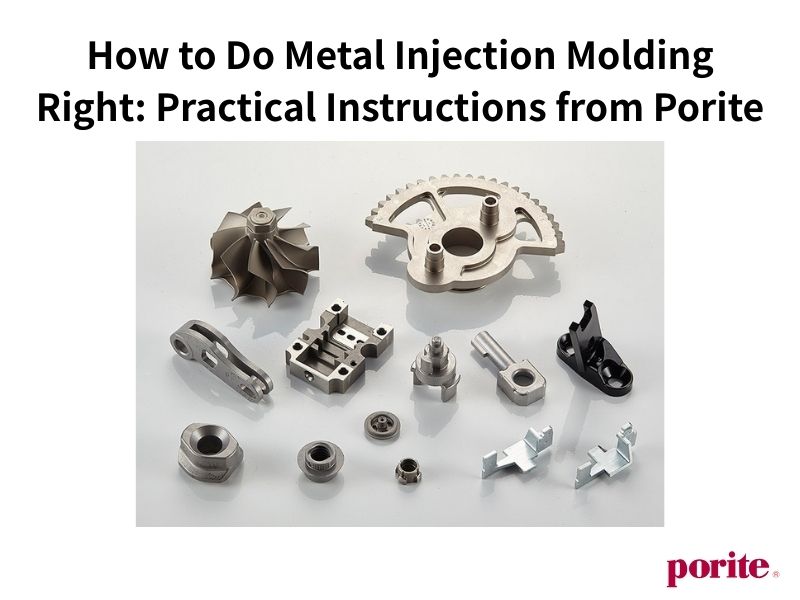
Metal Injection Molding (MIM) is a next-generation manufacturing process that blends the versatility of plastic injection molding with the material strength and performance of traditional metallurgy. It’s ideal for producing small, high-precision, and complex metal components in large volumes.
At Porite, we provide complete Metal Injection Molding solutions — from custom feedstock preparation to in-house mold design and high-capacity sintering. With decades of powder metallurgy experience, we help customers across industries realize their part designs with efficiency and precision. In this article, we’ll walk you through the Metal Injection Molding process and share the key instructions for a successful MIM production line.
Step 1: Preparing the Feedstock
The first step in Metal Injection Molding is creating a high-quality feedstock, which is a homogeneous blend of:
- Ultra-fine metal powder (e.g., stainless steel, alloy steel, titanium)
- A binder system (typically thermoplastic wax and polymer)
This feedstock is granulated into pellets, ready for injection molding. At Porite, we formulate and mix our own feedstock to meet various customer specifications.
Tip: Consistent powder distribution improves mold fill, reduces defects, and ensures final part density.
Step 2: Injection Molding
The feedstock is injected into a precision mold using conventional injection molding machines. This creates the green part, which has the desired geometry but lacks structural integrity.
- MIM molds are designed with shrinkage in mind (parts shrink approximately 15–20% during sintering).
- Complex 3D geometries, thin walls, and fine details are achievable.
Tip: Maintain precise temperature and injection pressure to ensure full mold fill and prevent flow lines or voids.
Step 3: Debinding
The green part undergoes debinding to remove the polymer binder:
- Solvent debinding removes the majority of binder safely.
- Thermal debinding gradually burns off the remainder without damaging the part.
The result is the brown part — fragile, porous, but chemically clean and ready for sintering.
Tip: Avoid rapid temperature ramps during thermal debinding to prevent internal cracks or deformation.
Step 4: Sintering
Sintering is the heart of the Metal injection Molding process. In this stage, the brown part in a furnace at high temperature (typically between 1300-1400°C), just below the melting point of the metal.
- Metal particles fuse at the atomic level to form a dense, solid metal structure.
- The part gains its mechanical properties and final shape.
At Porite, we utilize advanced vacuum furnaces and atmosphere control to ensure consistent quality and material performance.
Tip: Design for dimensional shrinkage and test furnace consistency to maintain tight tolerances.
Step 5: Optional Post-Processing
While Metal Injection Molding delivers near-net-shape parts, post-processing may be applied depending on performance needs:
- Heat treatment for improved hardness or tensile strength
- CNC machining for tight dimensional tolerances
- Surface finishing such as polishing, plating, or coating
Porite offers in-house machining and secondary processes to support end-to-end part delivery.
Tip: In the early design phase, plan which features require post-processing and which can be achieved during molding.
Why Choose Metal Injection Molding?
Compared to traditional machining or casting, Metal Injection Molding provides:
- Design Freedom – Ideal for complex, miniaturized geometries
- Material Efficiency – Less scrap, reduced raw material cost
- High Strength – Mechanical properties close to wrought metals
- Scalability – Suitable for both prototyping and mass production
At Porite, we support a wide range of materials for MIM, including stainless steel, low-alloy steel, soft magnetic alloys, and custom blends — making our MIM components suitable for:
- Automotive sensors and actuators
- Medical device components
- Consumer electronics hardware
- Industrial tools and connectors
Common Pitfalls to Avoid in MIM
- Using inconsistent powder size, which leads to density variations
- Ignoring shrinkage in mold design, resulting in dimensional inaccuracies
- Rushing the debinding process, causing internal voids or cracks
- Lack of furnace control, which can lead to incomplete sintering or deformation
Porite’s Commitment to Precision Metal Injection Molding
Porite is not just a MIM parts supplier — we’re a full-service metal injection molding partner. With fully integrated production lines, proprietary material development, and extensive sintering experience, we help customers bring complex metal parts to life efficiently and at scale.
Whether you need high-volume components or require support in the design stage, Porite is ready to deliver reliable, high-performance MIM solutions.
Get in Touch with Porite
Want to explore how Metal Injection Molding can elevate your product line?
Contact Porite Today
Let’s discuss how we can develop the right MIM solution for your project.