
新聞消息
媒體專區
台灣 SOFC 系統需求成長與粉末冶金零組件的關鍵角色
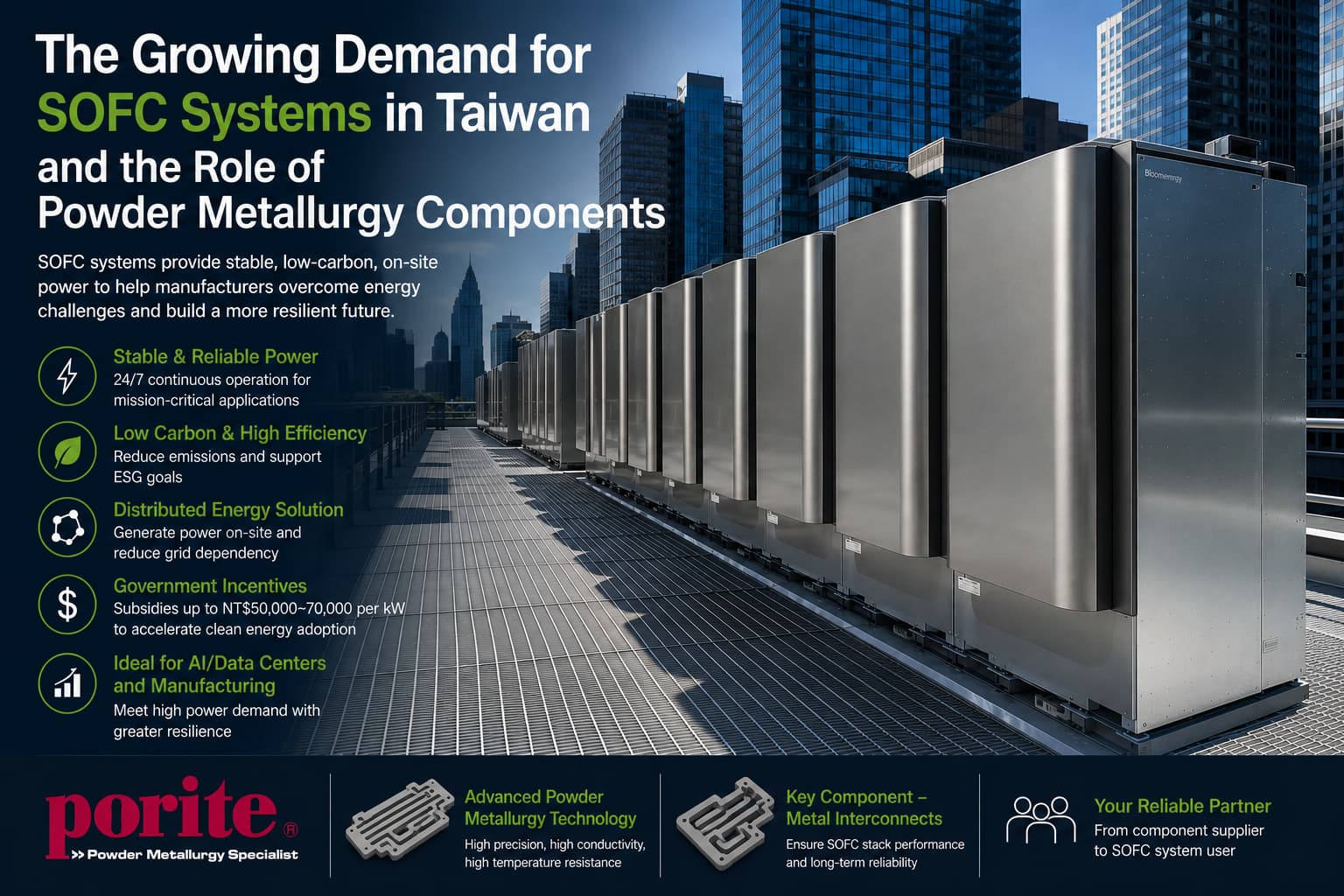
Taiwan’s energy landscape is changing rapidly. As AI data centers, semiconductor fabs, electronics manufacturing, and other high-energy industries continue to expand, manufacturers are facing a serious challenge: how to secure stable, low-carbon, and quickly deployable power without depending entirely on the traditional grid.
Recent reports show that Solid Oxide Fuel Cell (SOFC) systems are gaining attention in Taiwan as a distributed power solution. Taiwan’s government is encouraging the installation of stationary fuel cell systems, with subsidies reported at NT$50,000 to NT$70,000 per kW, a four-year budget of NT$7.4 billion, and an estimated 120MW of installation potential.
For manufacturers, this trend is not only about energy policy. It is about production stability, carbon reduction, and long-term competitiveness.
Why Manufacturers in Taiwan Are Facing Greater Energy Pressure
Manufacturers today are dealing with several power-related pain points.
First, electricity demand is rising quickly. AI servers and data centers require large amounts of stable 24-hour electricity. At the same time, Taiwan’s semiconductor, electronics, automation, and precision manufacturing sectors continue to expand. This creates stronger pressure on the power grid and increases the risk of insufficient power capacity for new projects.
Second, manufacturers cannot afford unstable electricity. For factories using continuous production lines, heat treatment, precision machining, powder metallurgy, or automated equipment, power interruptions can lead to production losses, quality issues, equipment downtime, and delivery delays.
Third, global customers are asking suppliers to reduce carbon emissions. Many manufacturers are under pressure to improve ESG performance, reduce Scope 2 emissions, and demonstrate a practical energy transition strategy.
This is why distributed energy systems are becoming more important. Instead of relying only on centralized power plants and grid transmission, companies are beginning to evaluate on-site power generation solutions that can provide stable electricity closer to the point of use.
Why SOFC Systems Are Becoming a Practical Solution
SOFC systems are attracting attention because they can provide stable baseload power. According to recent industry reports, SOFC systems can use hydrogen or natural gas as fuel, operate 24 hours a day, and provide immediate on-site electricity without requiring a separate energy storage system. Installation time has also been reported as around 90 days, making SOFC a faster option for factories and data centers that urgently need power.
For manufacturers, the key advantages include:
| Manufacturer Pain Point | SOFC System Advantage |
|---|---|
| Unstable grid power or limited power capacity | On-site distributed power generation helps reduce dependence on centralized grid supply. |
| High demand for 24/7 production | SOFC systems can provide continuous baseload electricity. |
| Pressure to reduce carbon emissions | SOFC offers a lower-carbon power option compared with traditional fossil-fuel power generation. |
| Long waiting time for power infrastructure | SOFC systems can be deployed more quickly than many large-scale energy infrastructure projects. |
| Need for flexible factory energy planning | Modular system design supports phased installation and future expansion. |
This makes SOFC especially relevant for high-power industries such as semiconductor manufacturing, AI data centers, precision manufacturing, hospitals, and factories that cannot tolerate power interruptions.
Taiwan’s Policy Support Creates New Market Opportunities
Government support is another reason SOFC is gaining momentum in Taiwan. Reports indicate that Taiwan is encouraging companies to install stationary fuel cell power systems, with subsidies of NT$50,000 to NT$70,000 per kW and a four-year budget of NT$7.4 billion.
This policy support creates two important opportunities.
For end users, such as factories and data centers, subsidies can reduce the initial investment burden and shorten the payback period. For equipment manufacturers and component suppliers, the growing SOFC market creates new demand for reliable, high-performance components.
This is where powder metallurgy becomes highly important.
The Importance of Powder Metallurgy Components in SOFC Systems
SOFC systems operate under demanding conditions. They require components that can withstand high temperatures, maintain dimensional stability, support electrical conductivity, and deliver long-term reliability.
One of the most critical components is the metal interconnect. In an SOFC stack, interconnect plates help connect individual cells, conduct electricity, separate fuel and air channels, and support stable system performance. Because SOFC systems operate at high temperatures, the interconnect must meet strict requirements for heat resistance, oxidation resistance, conductivity, and precision.
Powder metallurgy is well suited for this type of application because it can produce complex metal parts with consistent material properties, controlled density, and stable mass production quality.
For SOFC system manufacturers, choosing the right powder metallurgy partner is not only a purchasing decision. It directly affects stack reliability, production scalability, and long-term system performance.
Porite’s Role as a Powder Metallurgy Partner for SOFC Systems
Porite Taiwan has been investing in the energy industry since 2005 and has become a supplier of components for solid oxide fuel cells. Porite also has been involved in SOFC component development since 2006 and currently produces over one million SOFC-specific metal interconnects annually.
This makes Porite more than a general powder metallurgy manufacturer. It positions the company as a specialized powder metallurgy partner for SOFC systems.
Porite’s role can be understood from two angles.
First, Porite is a supplier of SOFC key components. Reports state that Porite produces critical interconnect plate components for SOFC systems and is a long-term supplier to Bloom Energy. As Bloom Energy’s orders increase, Porite’s interconnect plate capacity has also continued to expand, with reported projections reaching 20 million pieces in 2027 and 30 million pieces in 2028.
Second, Porite is also an SOFC user. Porite installed its first 650kW SOFC system at its Zhunan plant in October 2024, and its second 650kW system was installed and began operation on January 23, 2026.
This is a meaningful point for industrial customers. Porite is not only producing SOFC components; it is also applying SOFC technology in its own factory. This gives Porite practical experience from both the supply chain side and the user side.
Suggested Energy Strategy for Manufacturers
For manufacturers evaluating SOFC, the key question is not simply whether to install a fuel cell system. The more important question is how SOFC fits into a broader energy strategy.
A practical approach may include:
- Evaluating current and future electricity demand
- Identifying production areas where power interruption would cause the highest risk
- Reviewing available government subsidies and installation requirements
- Comparing SOFC with solar power, storage systems, and traditional backup power
- Considering phased installation to reduce investment pressure
- Working with experienced SOFC system providers and reliable component suppliers
For factories with high power demand, SOFC can become part of a distributed energy strategy that improves power stability, supports carbon reduction, and strengthens long-term manufacturing resilience.
Conclusion
Taiwan’s growing demand for SOFC systems is being driven by energy policy, AI and data center power consumption, manufacturing power shortages, carbon reduction pressure, and the rise of distributed energy systems.
For manufacturers, SOFC offers a practical path toward stable, low-carbon, on-site power generation. For the SOFC supply chain, high-performance powder metallurgy components are essential to system reliability and scalability.
As a long-term supplier of SOFC interconnect components and an actual SOFC system user, Porite Taiwan demonstrates how powder metallurgy expertise can support the future of clean energy infrastructure. In Taiwan’s expanding SOFC market, the role of a reliable powder metallurgy partner for SOFC systems will become increasingly important.